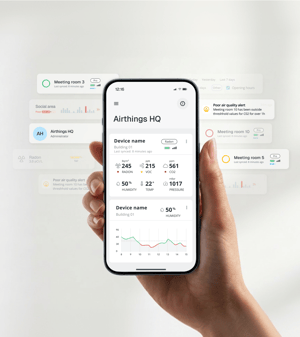



Mold Risk
Understand, monitor, and reduce the risk of mold growth across your portfolio using real-time temperature and humidity data.
How does mold grow indoors?
Mold spores are present in almost all indoor air, invisible to the eye until they land on a surface where conditions allow them to grow. Once established, mold can spread across surfaces and into materials, often hidden behind walls, panels and ceilings.
Whether mold grows depends on three conditions: humidity (which provides the moisture mold needs), temperature (which affects how quickly mold develops), and time (how long these conditions last). The Mold Risk Indicator doesn't detect mold itself. Instead, it shows how conditions in a space affect the potential for mold growth over time, so you can act before it starts.

Stop reacting. Start optimizing.
Gain complete visibility into your building operations, eliminate budget surprises,and transition from "firefighting" to high-performance management.

Built for facility mangers
→ Get a quick overview of your entire portfolio from anywhere
→ Prioritize worst-performing spaces first
→ Generate compliance reports in minutes, not hours
→ Real-time alerts when conditions exceed thresholds
→ Use trend data to predict and prevent issues
→ Fix problems before they become complaints
→ Connect to your BMS for automated HVAC optimization
→ Receive alerts in Slack, Teams, or email
→ API access for custom dashboards and analytics
→ Fully wireless sensors, no complex cabling
→ Long battery life means minimal maintenance
→ Scale easily as your portfolio grows
What do the risk levels mean?
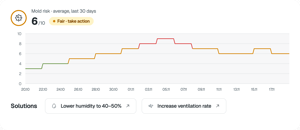
The Airthings Mold Risk Indicator combines these signals into a single score from 0 to 10, so you can see where conditions favor mold growth and act before it becomes a problem.0-2
Status: This is normal
Conditions don't favor mold growth
Recommended action
Maintain current humidity, temperature, and ventilation
3-7
Status: Take action
Conditions are starting to favor mold growth
Recommended action
Follow the dashboard's suggestions to lower humidity and improve ventilation
8-10
Status: Warning
Conditions strongly favor mold growth
Recommended action
Act immediately: reduce humidity, increase ventilation and check for leaks or condensation. Dry out water-damaged areas within 24-48 hours.
How the mold risk indicator works
A single score per space, based on temperature and humidity data, with the context to act on it.
Find the cause
Set results quickly
The three factors that drive mold growth
The Mold Risk Indicator is based on ANSI/ASHRAE Standard 160, a physical model built on laboratory research into how mold grows in different environments, and combines three factors into a single score.
FACTOR 1
Humidity
When relative humidity stays above around 70–75% over time, surfaces and materials absorb enough moisture for spores to settle and spread.
FACTOR 2
Temperature
Mold grows fastest in moderate to warm conditions. Temperature also affects humidity, and cold surfaces can cause condensation where mold easily takes hold.
FACTOR 3
Time
Mold growth is a gradual process. Short periods of high humidity, like after a shower, pose little risk, but conditions that persist over hours and days allow mold to establish and grow.
Why monitor mold risk?
Mold often grows out of sight, and by the time it's visible, damage has usually been done. Monitoring the conditions that drive mold growth gives building operators three things they can't get from visual inspections alone.
Catch problems early
Protect occupant health
Avoid costly repairs
● GET STARTED
See mold risk indicator in your buildings
Curious how mold risk behaves across your spaces? We'll show you what the Mold Risk Indicator looks like in the dashboard and how facility teams use it to prevent mold before it grows.

Stop ventilating empty rooms
Our sensors detect when people are actually present. Integrate with your BMS to reduce HVAC run-time by up to 30%.
See how Toma saved 26% on energy bills ->
Explore related insights
Mold risk is one signal among many. Combine it with these for a complete view of your indoor environment.