Ventilation Rate
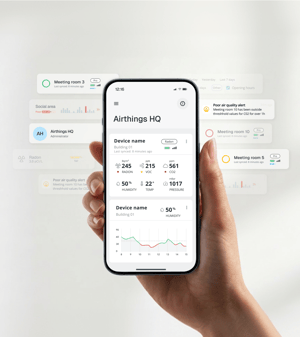
Make informed decisions about your building's ventilation system using the estimated Air Exchange Rate (ACH),
calculated in real time and visible in the Airthings for Business Dashboard.
What is Air Exchange Rate (ACH)?
Air Exchange Rate (ACH) is the number of times the air in a room is fully replaced with fresh air each hour. It is the standard measure of ventilation effectiveness: a higher ACH generally means better indoor air quality and lower accumulation of pollutants, CO₂, and airborne pathogens. ACH is calculated from the room's volume and the airflow rate of the ventilation system serving it.
Stop reacting. Start optimizing.
Gain complete visibility into your building operations, eliminate budget surprises,and transition from "firefighting" to high-performance management.

Built for facility mangers
→ Get a quick overview of your entire portfolio from anywhere
→ Prioritize worst-performing spaces first
→ Generate compliance reports in minutes, not hours
→ Real-time alerts when conditions exceed thresholds
→ Use trend data to predict and prevent issues
→ Fix problems before they become complaints
→ Connect to your BMS for automated HVAC optimization
→ Receive alerts in Slack, Teams, or email
→ API access for custom dashboards and analytics
→ Fully wireless sensors, no complex cabling
→ Long battery life means minimal maintenance
→ Scale easily as your portfolio grows
How ventilation rate works
Ventilation Rate is an AI-powered virtual sensor that calculates Air Exchange Rate (ACH) to show how efficiently your building's ventilation system is performing, with no extra hardware required.
Track ventilation
Correlate with other insights
Why does ventilation rate matter?
Ventilation isn't just about comfort. It directly affects health, energy costs, and whether a building meets regulatory standards. Tracking the Air Exchange Rate turns those three abstract goals into something you can measure and act on.
Improve indoor air quality
Higher air exchange rates mean better ventilation and lower risk of airborne virus spread, CO₂ buildup, and pollutant accumulation. Track changes to confirm whether your adjustments actually improve the air.
Drive energy efficiency
Use real occupancy and CO₂ data to identify under- or over-ventilation. Adjust ventilation schedules to actual usage instead of fixed office hours, cutting waste without cutting comfort.
Achieve regulatory compliance
Meet the requirements for minimum ventilation rates based on room size and type, as set by industry and local building codes and standards.
● GET STARTED
See ventilation rate in your buildings
Curious how your buildings are actually ventilating? We'll show you what Ventilation Rate looks like in the Airthings dashboard, with the metrics that matter for your spaces.

Stop ventilating empty rooms
Our sensors detect when people are actually present. Integrate with your BMS to reduce HVAC run-time by up to 30%.
See how Toma saved 26% on energy bills ->
Resolve complaints with facts
When a tenant claims air quality is poor, share a live link to the data. Prove your building is performing - or spot the exact issue instantly.
Explore related insights
Ventilation Rate is one signal among many. Combine it with these for a complete view of your indoor environment.