
 Loading...
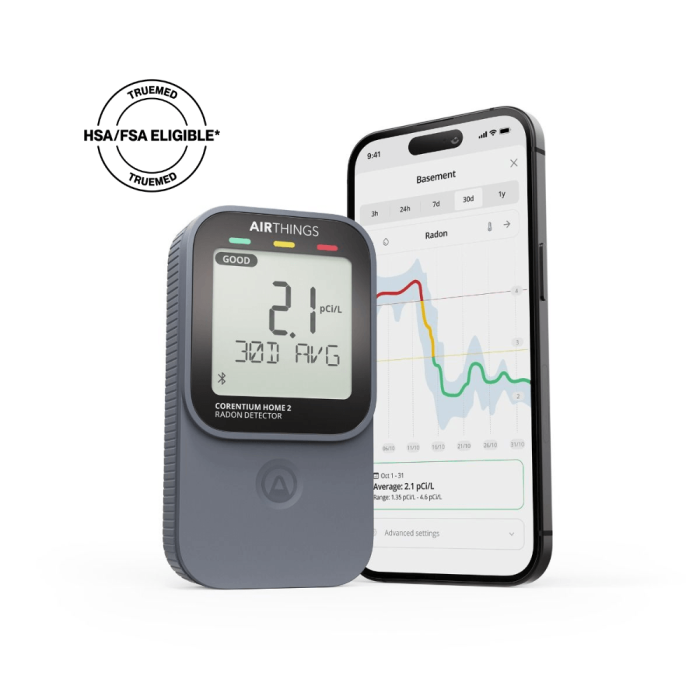
Radon detector Corentium Home 2
Monitor the air around you
 Radon
Radon
You can't see or smell it, but long-term exposure to this radioactive gas is the top cause of lung cancer in non-smokers.
 Temperature
Temperature is not just a matter of comfort, it can negatively affect sleep quality, mood, and alertness.
 Humidity
High humidity promotes mold growth and aggravates asthma symptoms, while too-dry air can lead to skin and throat irritation.
Why radon monitoring matters
The invisible risk in 1 in 15 US homes
Radon is a colorless, odorless radioactive gas that enters homes through foundations, floors, and cracks. The only way to know your home's radon level is to measure it.
Second leading cause of lung cancer
According to the U.S. Environmental Protection Agency (EPA), radon is the second leading cause of lung cancer in the United States, responsible for approximately 21,000 deaths each year.
1 in 15 US homes exceeds the EPA action level
The EPA recommends taking action when long-term radon levels reach 4 pCi/L or above. Approximately 1 in 15 US homes is at or above that threshold — and radon levels vary street by street, not just state by state.
No smell, no color, no warning
Radon is impossible to detect without a monitor. It concentrates on lower floors and in basements — especially during fall and winter when homes are sealed. Testing is the only way to know.
What it measures
Three sensors. One device.
Continuous monitoring for the three factors that matter most in basements and lower floors — no Wi-Fi required.
- Radon
- 24h, 7d, 30d and long-term rolling averages. EPA action level: 4 pCi/L.
- Temperature
- Tracks ambient temperature in the spaces where you monitor for radon.
- Humidity
- Flags damp conditions — mold risk rises above roughly 60% relative humidity.
Trusted since 2011
The most trusted digital radon detector in the world
Airthings introduced Corentium Home in 2011, setting the benchmark for reliable, continuous radon monitoring. The Airthings Corentium Home 2 builds on that legacy with Bluetooth connectivity, the Airthings app, and temperature and humidity sensors — the same trusted accuracy, now even smarter.
Recommended by radon professionals and trusted by over half a million homeowners worldwide.
Simple setup
Not knowing is hard. Testing is easy.
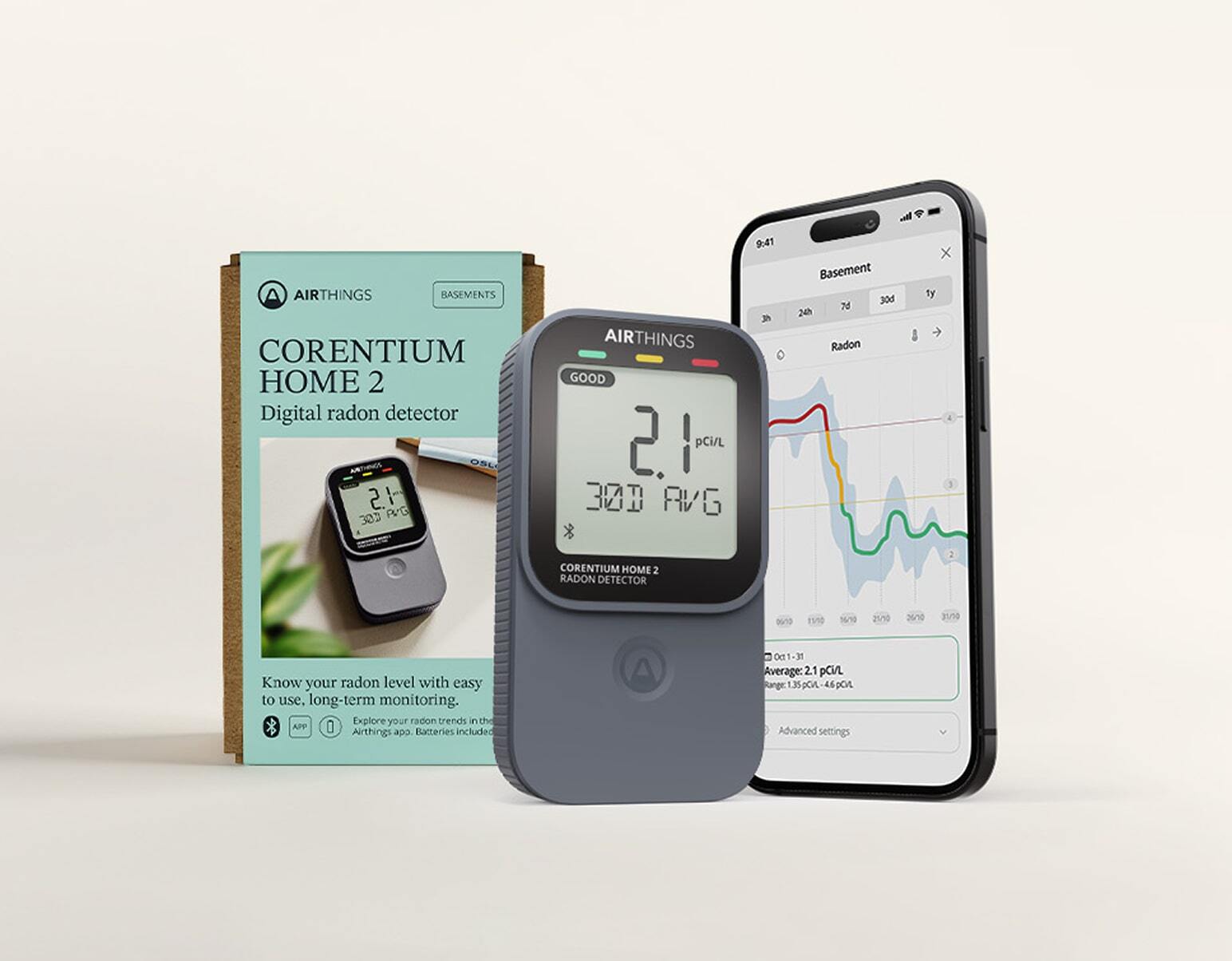
Setting up the Airthings Corentium Home 2 takes under two minutes. Pull the battery tab to start measuring radon immediately — no Wi-Fi required, no cables, no installation.
Download the free Airthings app on iOS or Android, connect via Bluetooth, and your radon readings appear in clear graphs with personalized guidance on what they mean.
- Up to 3-year battery life
- Runs on 2 AA batteries. No charging, no cables.
- Bluetooth & SmartLink
- Connect via Bluetooth or link to an Airthings Hub for 24/7 remote access.
Bonus sensors
Why track humidity and temperature?
The Airthings Corentium Home 2 adds temperature and humidity sensors because basements and lower floors — where radon concentrates — are also where moisture problems are most common.
- Humidity — mold prevention
- Mold thrives above roughly 60% relative humidity. The Corentium Home 2 flags damp conditions so you can act before damage sets in.
- Temperature — comfort and sleep
- Temperature affects sleep quality, mood, and alertness. Tracking it in the spaces you monitor for radon gives you a fuller picture of your home environment.
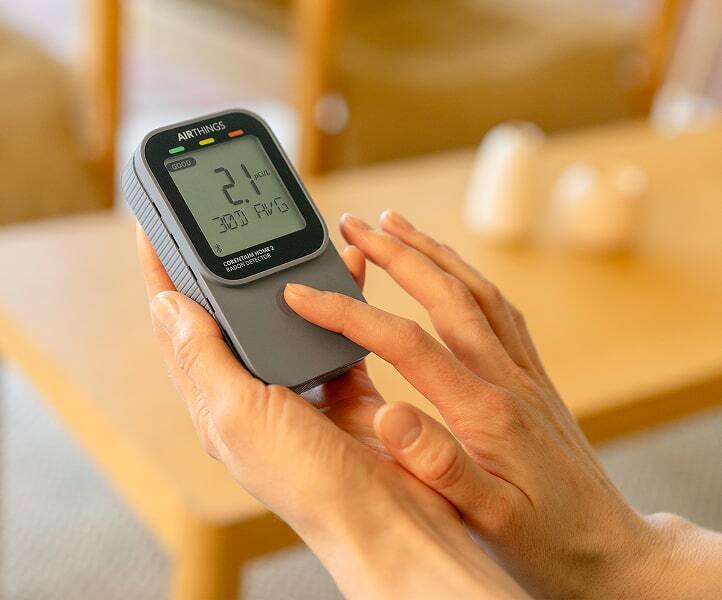
Device features
Everything you need. Nothing you don't.
The Airthings Corentium Home 2 is designed to be simple to use and simple to understand — from first setup to long-term radon awareness.
What's new
How does Corentium Home 2 compare?
The Airthings Corentium Home 2 is a significant upgrade over the original — adding Bluetooth connectivity, the Airthings app, two bonus sensors, and better battery life in a slimmer design.
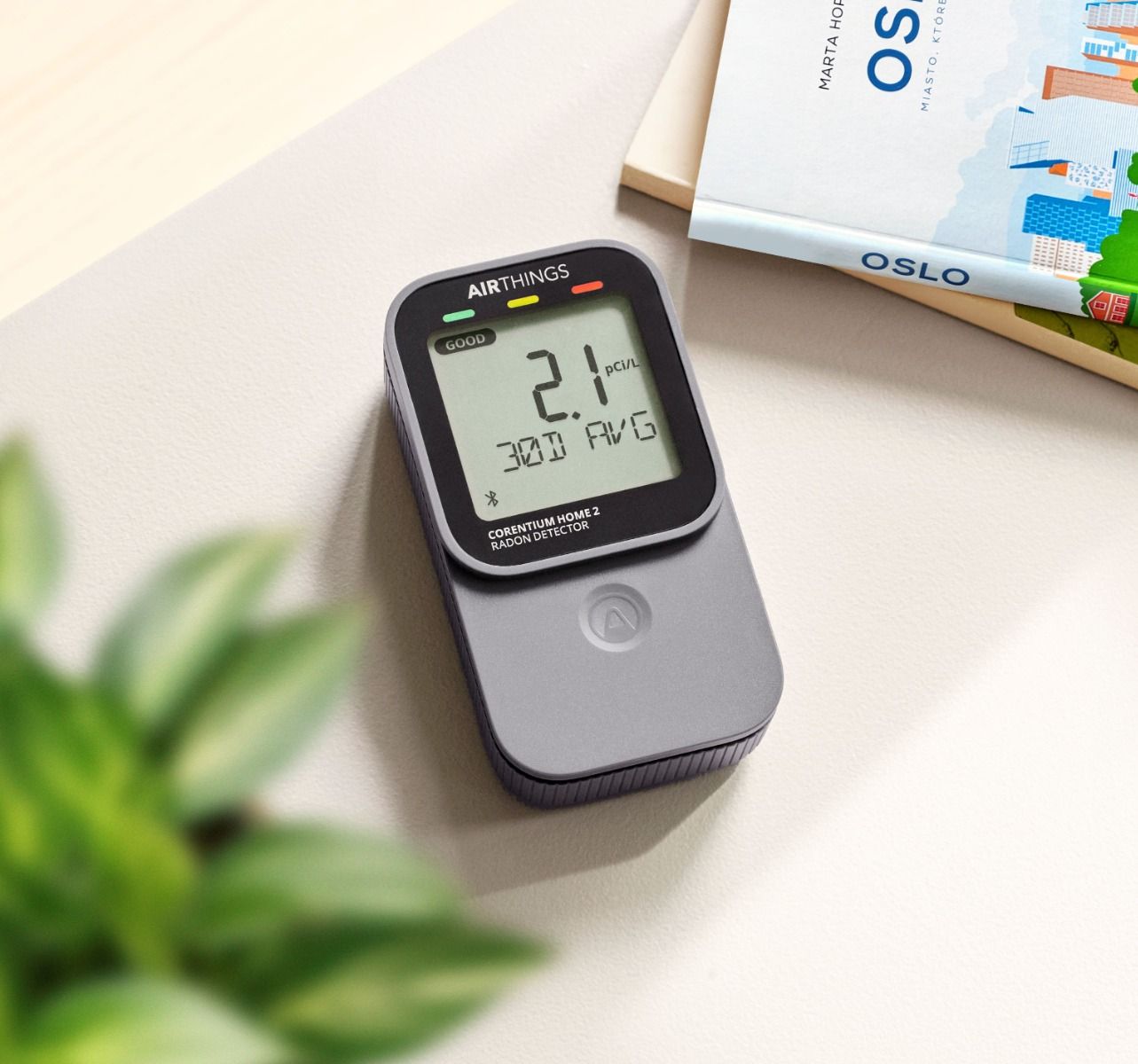
Corentium Home 2
Current model
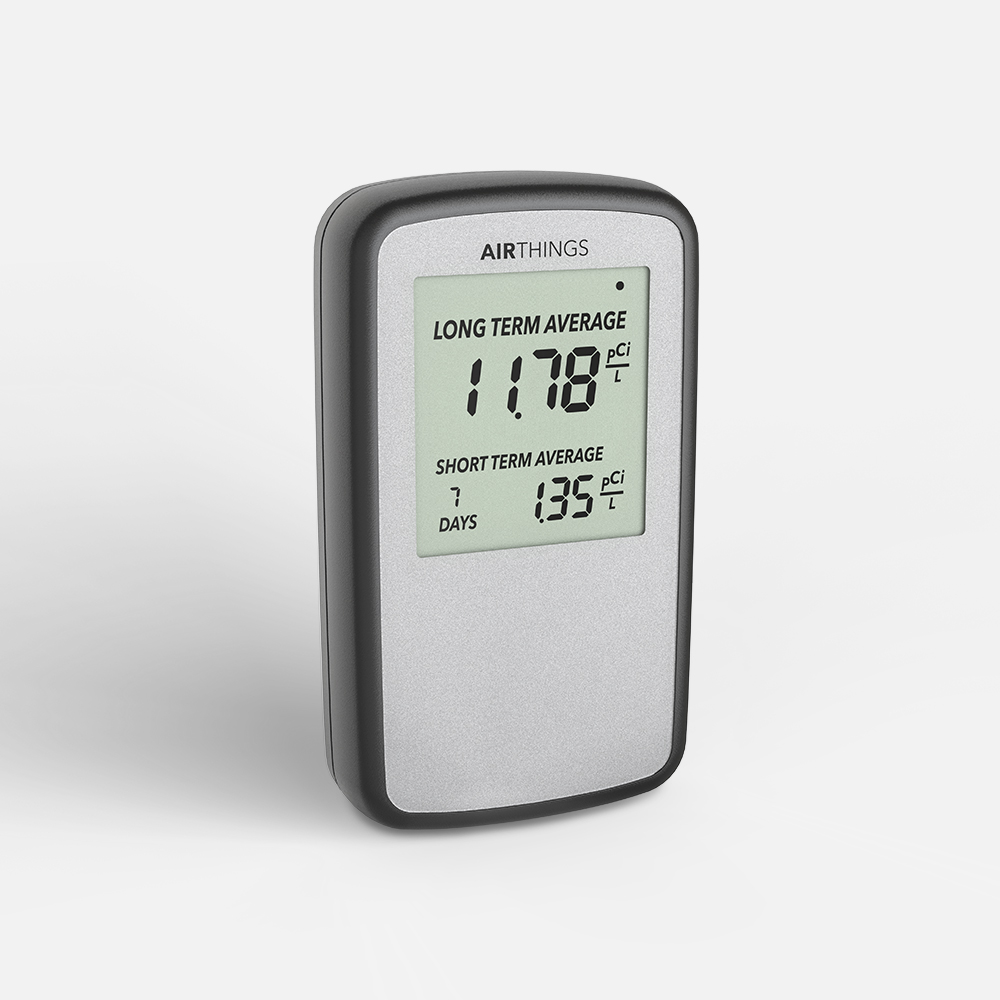
Corentium Home 1
Previous model
- Connectivity
- Yes
- No
- Sensors
- Radon, Temperature & Humidity
- Radon only
- Power source
- 2 AA batteries
- 3 batteries
- Battery life
- Up to 3 years
- 2 years
-
Radon level indicator
Poor / Fair / Good - Yes
- No
- Data history
- Full
- Partial
- Radon in-app insights
- Yes
- No
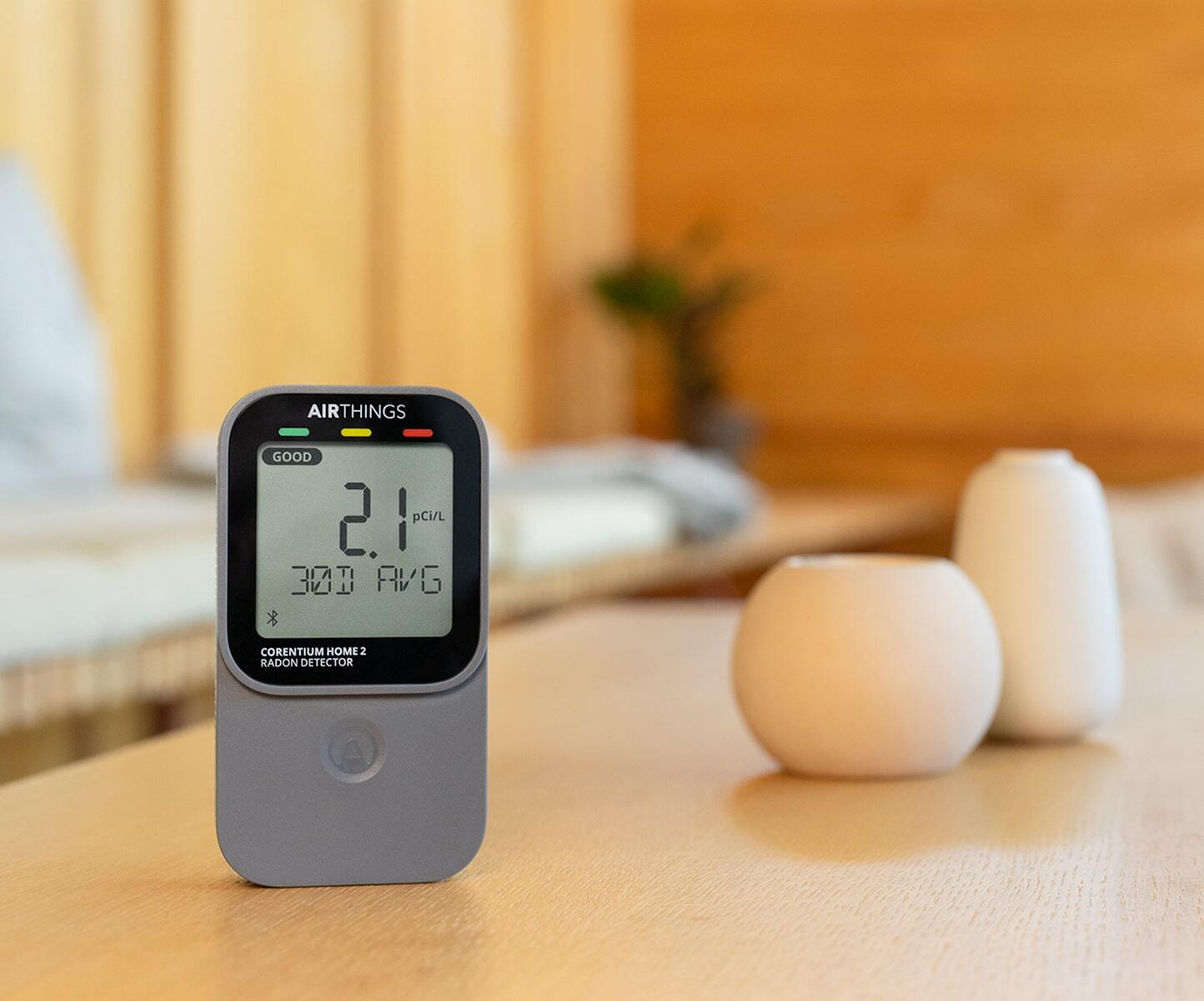
Placement guide
Where should you place a radon detector?
The Airthings Corentium Home 2 should be placed on the lowest livable floor of your home — typically the basement or ground floor — because radon gas enters from the ground and concentrates at lower levels.
-
1
Lowest livable floor first
Place the monitor in your basement if you use it regularly. If your basement is unfinished and unoccupied, the ground floor is the right choice. Radon levels on lower floors are typically higher than upper floors.
-
2
Away from drafts and exterior walls
Keep the monitor at least 20 inches above the floor and away from windows, exterior walls, HVAC vents, and sump pumps, which can skew readings by diluting or concentrating radon locally.
-
3
Measure during fall and winter
Radon concentrations are typically highest in fall and winter when homes are sealed and ventilation is reduced. The EPA recommends measuring for several weeks to get an accurate long-term average.
Airthings app
What does the Airthings app show you?
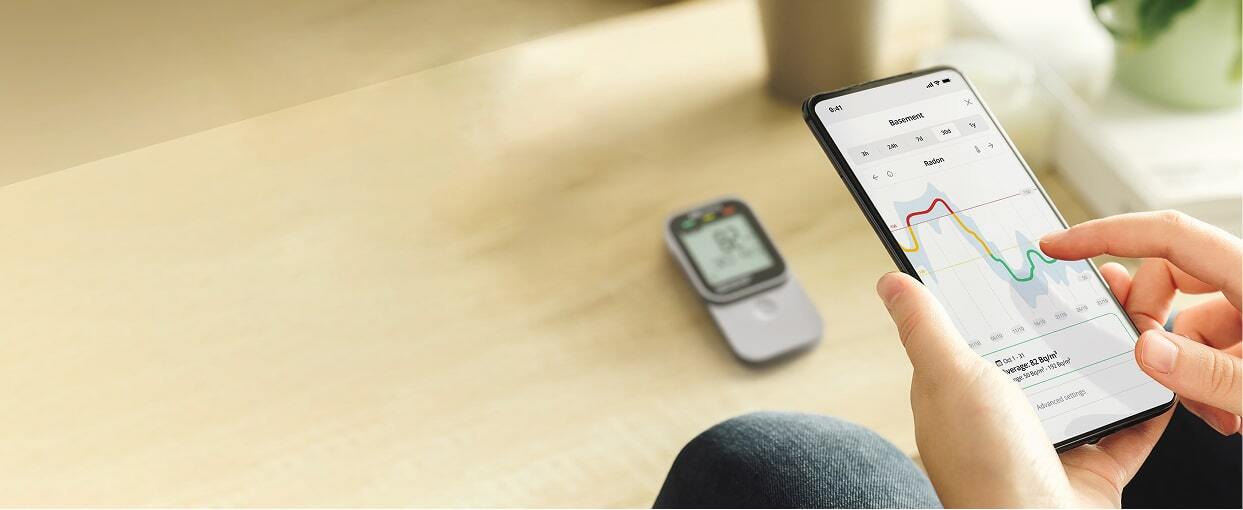
The free Airthings app (iOS and Android) shows your radon, temperature, and humidity readings in real-time graphs — with personalized guidance explaining what your levels mean and what to do next.
Airthings Corentium Home 2 — setup and app walkthrough
Common questions
Frequently asked questions
- What radon level should I act on?
- The EPA recommends taking action when long-term radon levels reach 4 pCi/L (148 Bq/m³) or above. The WHO recommends a reference level of 100 Bq/m³ (2.7 pCi/L). Both agencies recommend investigating mitigation options when levels exceed these thresholds. The Airthings app shows whether your reading is in the Good, Fair, or Poor range and explains what to do next.
- Where should I place the Corentium Home 2?
- Place the Airthings Corentium Home 2 on the lowest livable floor of your home — the basement if you use it regularly, or the ground floor if your basement is unfinished. Keep it at least 20 inches above the floor and away from exterior walls, windows, and HVAC vents. Radon concentrates on lower floors and levels are typically highest in fall and winter when homes are sealed.
- What is a "rolling average" and why does it matter?
- A rolling average shows trends by averaging radon data over a moving time window. The 7-day rolling average updates daily — it adds the newest day's data and drops the oldest. This smooths out short-term fluctuations caused by weather, ventilation changes, and daily activity. Higher rolling averages than your long-term average indicate rising radon levels; lower averages indicate improvement. The EPA bases its action level on long-term averages, so rolling averages are the right metric to watch.
- How long should I measure for radon?
- The Airthings Corentium Home 2 measures continuously and shows your first 24-hour average after one full day. For reliable long-term results, measure for several weeks — radon levels fluctuate with weather, seasons, and ventilation. The EPA recommends measuring for at least 90 days during colder months (fall and winter) for the most accurate baseline. If you have a mitigation system installed, continuous monitoring confirms it is working correctly.
- Can I use the Corentium Home 2 without the Airthings app?
- Yes. The Airthings Corentium Home 2 works as a standalone device — the LCD screen displays your 24-hour, 7-day, 30-day, and long-term radon averages, plus temperature and humidity, without any app or connectivity needed. The free Airthings app adds historical graphs, personalized guidance, SmartLink remote access, and in-app alerts, but the device measures and displays radon independently.
- Why wait 24 hours for the first radon reading?
- Radon levels fluctuate significantly throughout the day due to changes in pressure, ventilation, and activity. The Airthings Corentium Home 2 uses 24-hour rolling averages rather than instantaneous readings to provide a statistically meaningful result. Your first average appears after one full day of data collection. Shorter readings can be misleading — a spike or dip in one hour does not represent your home's actual radon exposure.
- Why choose Airthings for radon monitoring?
- Airthings has been making digital radon monitors since 2011 and the Corentium Home sensor technology is trusted by over half a million homeowners and recommended by radon professionals. The patented alpha spectrometry sensor measures radon across a range of 0–250 pCi/L with a typical accuracy within 10%. A free 5-year warranty is available with device registration within 30 days of purchase.
- Is the Corentium Home 2 HSA/FSA eligible?
- Yes. The Airthings Corentium Home 2 is eligible for purchase with Health Savings Account (HSA) or Flexible Spending Account (FSA) funds through Truemed. After completing your purchase on airthings.com, you will fill out a short Truemed intake form to qualify. Using pre-tax HSA or FSA dollars effectively reduces the out-of-pocket cost of the device.
Ratings & reviews
Welcome!
You're shopping international
Enjoy more personalized experience by shopping in your local store.