What is particulate matter? A guide to PM1, PM2.5 and PM10 and how it affects our health
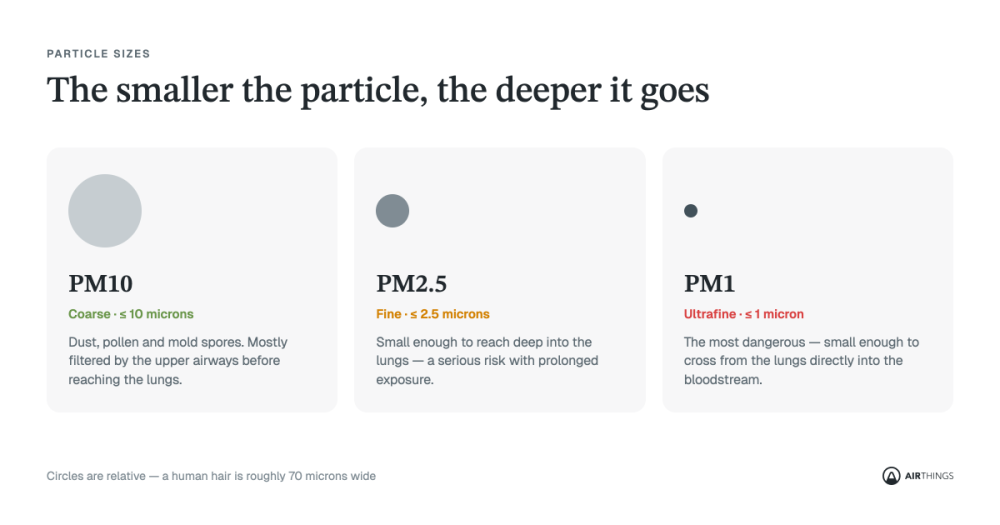
TL;DR: PM, or particulate matter, refers to tiny airborne particles that are invisible to the naked eye. The particles are categorized by size. Coarse particles (PM10) have a diameter of 10 microns or less and include dust, pollen, and mold spores; these are generally filtered by the upper respiratory tract before reaching the lungs. Fine particles (PM2.5) have a diameter of 2.5 microns or less, small enough to penetrate deep into the lungs and pose a serious health risk with prolonged exposure. Ultrafine particles (PM1) have a diameter of 1 micron or smaller and are the most dangerous to human health, as they can cross from the lungs directly into the bloodstream.
PM originates from both natural and human-generated sources, including industrial activity, vehicle emissions, wildfires, cooking, and other combustion and particle-generating activities such as lighting candles, using fireplaces, and even vacuuming. Exposure to high levels of PM can cause eye and respiratory irritation. Over time, fine and ultrafine particles can be inhaled deep into the lungs, bypassing the body’s natural defense systems, and enter the bloodstream. These can cause serious health problems, including cardiovascular disease, respiratory disease, and premature death.
Particulate matter (PM) is a complex mixture of tiny solid particles and liquid droplets suspended in the air. PM includes everything from dust, dirt, and pollen to soot, smoke, and complex chemicals.
What does particulate matter look like?
When we think of air pollution, we usually picture thick smog hanging over a city skyline or dark smoke billowing from a factory. While some PM is large enough to see, the most harmful particles are microscopic. Because they are so small, they can bypass your body’s natural defenses, traveling deep into your lungs and even entering your bloodstream. As the EPA (US Environmental Protection Agency) reports, fine particles are also the main cause of reduced visibility (haze) in parts of the United States.
Is particulate matter dangerous?
Yes. According to the American Lung Association’s latest State of the Air report, over 156 million Americans are currently exposed to unhealthy levels of air pollution, driven heavily by spikes in fine particulate matter created by wildfires and extreme heat. When the AQI (Air Quality Index) is poor outside, this is generally due to high levels of PM detected.
Here is everything you need to know about particulate matter indoors, the difference between particle sizes, and how to protect the air inside your home.
Are there different sizes of particles, and how are they measured?
Particulate matter includes many different substances and sizes, so it is categorized by size rather than chemical composition. The size of the particle will affect how deeply it can penetrate your respiratory system.
PM is measured in micrometers (or microns, represented by the symbol µm). For context, a single strand of human hair is about 50 to 70 microns in diameter.
- Coarse particles (PM10): These are particles with a diameter of 10 microns or less. This category includes dust, pollen, and mold spores. While irritating to the eyes, nose, and throat, PM10 particles are usually filtered out by the mucous membranes in your upper respiratory tract before they reach your lungs.
- Fine particles (PM2.5): These are particles with a diameter of 2.5 microns or less (about 30 times smaller than a human hair). PM2.5 is the primary cause of reduced visibility (haze) and poses a severe health risk because these particles can travel deep into the lower lungs.
- Ultrafine particles (PM1): These particles are 1 micron or smaller. They are so microscopic that they can cross the lung barrier directly into the bloodstream, traveling to major organs like the heart and brain.
(Note: These categories are inclusive. A measurement of PM10 inherently includes all PM2.5 and PM1 particles within that volume of air.)
Where does particulate matter in my home come from?
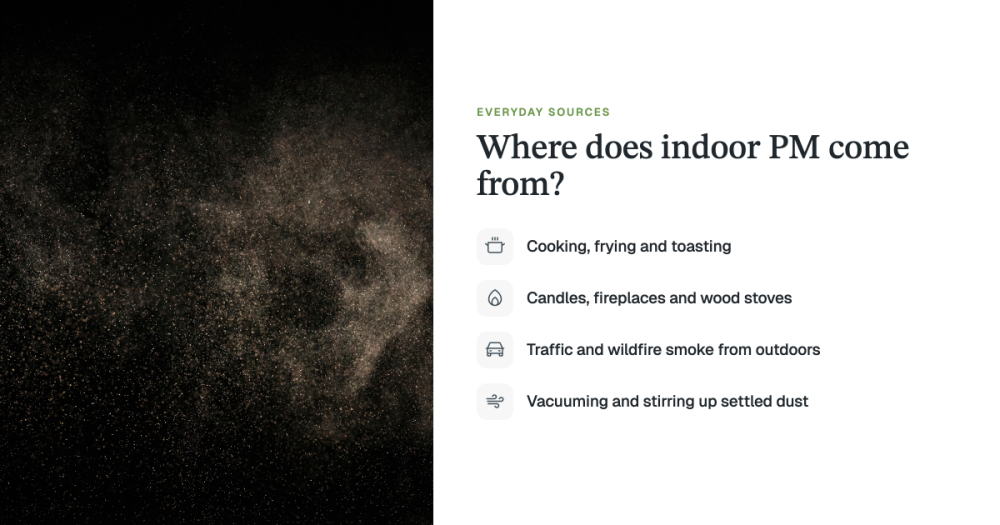
Particulate matter comes from both natural and human-made sources. While we often worry about outdoor pollution, indoor activities can actually cause PM levels inside your home to spike higher than the air outside.
Outdoor sources of particulate matter
-
Combustion, construction, agriculture, and vehicles: Exhaust from cars and diesel trucks, emissions from coal-fired power plants, and industrial manufacturing are major drivers of PM2.5. According to the California Air Resources Board, PM also comes from construction sites, landfills, and agriculture.
Interesting fact: Fireworks, a staple of celebrations across the world, can contribute to elevated PM2.5 levels. The colorants and explosives alongside metals and fuses all contribute to particulate matter spikes. For example, a 2015 study showed that PM2.5 levels were 42% higher during the 4 July holiday. The areas closest to large firework displays in the US that day saw the PM2.5 concentration nearly quadruple.
- Wildfires: In the US, wildfire smoke has become a dominant source of severe PM2.5 spikes, carrying toxic particles thousands of miles across the country and even across continents and oceans, especially when buildings or industrial materials are also burned. For example, the Canadian wildfires in the summer of 2025 affected air quality across large parts of Europe.
- Natural events: Windblown dust, sea spray, and volcanic activity contribute to coarse PM10 levels.
Note that while these sources of PM originate outdoors, they can also enter your home through windows, doors, ventilation systems, and even stick to your shoes and clothing. This outdoor PM can then contribute to high levels of particulate matter indoors.
Indoor sources of PM
- Cooking: Pan-frying, searing meat, and using gas stoves without proper ventilation create massive amounts of indoor PM2.5.
- Indoor combustion: Burning candles, using incense, smoking cigarettes, using a fireplace, or running unvented space heaters all release fine particles directly into your living space.
- Biological sources: Pet dander, mold spores, and agitated house dust all contribute to indoor PM10 levels.
- Everyday activities: Vacuuming, ironing, and even using a hair dryer can all cause PM2.5 spikes.
How does PM harm my health?
The World Health Organization (WHO) estimates that millions of premature deaths occur annually due to exposure to fine particles. The State of Global Air 2025 report highlights that PM2.5 exposure is increasingly linked not just to respiratory issues, but to noncommunicable diseases.
- Short-term health effects: Breathing in high levels of PM can cause immediate irritation of the eyes, nose, and throat. It triggers runny noses, coughing, and sneezing, and can cause severe flare-ups for individuals suffering from asthma or seasonal allergies.
- Long-term health effects: Chronic exposure to PM2.5 and PM1 is linked to aggravated coronary and respiratory diseases. Because these particles enter the bloodstream, long-term exposure increases the risk of heart attacks, stroke, chronic obstructive pulmonary disease (COPD), lung cancer, and even cognitive decline and dementia.
A study from the University of Pennsylvania found that exposure to high concentrations of air pollution could worsen Alzheimer’s disease (AD) by accelerating the buildup of toxic proteins in the brain and speeding up cognitive decline.
Case study: measuring wildfire PM and health impacts in LA homes
Following the 2025 Los Angeles wildfires, a team from Harvard’s Healthy Buildings Program deployed to 50 homes to study the pollutants penetrating indoor spaces in the aftermath, and what residents could do to reduce their exposure. As part of that research, scientists drew on data from more than 1,000 Airthings air quality sensors that had already been installed in LA homes before the fires broke out.
The findings were stark. Toxic chemicals including benzene, linked to anemia, leukemia, and low birth weights, were detected at high indoor concentrations weeks after the fires, long after many residents had assumed the air had cleared. Researchers urged people in affected areas to use air purifiers, air quality sensors, and appropriate masks.
As Harvard’s Joe Allen put it, the message was simple:
Be really careful what you’re doing indoors.
The study is ongoing, with scientists tracking residents’ health for at least a decade.
Source: Science, 2025.
PM2.5 can also affect performance at work
A one-year study by Harvard University examined participants in offices across six countries, working in different types of job, such as engineering, investment, tech, and architecture. The study found that increased concentrations of PM2.5 and lower ventilation rates (measured using carbon dioxide (CO₂) levels as a proxy) resulted in slower response times and reduced accuracy on a series of cognitive tests. The conclusion of the study was that exposure to high PM2.5 levels was associated with acute reductions in cognitive function.
Particulate matter impacts sleep quality
PM2.5 exposure also negatively affects sleep quality and duration. Researchers from the Johns Hopkins University School of Nursing found that sustained exposure to high PM2.5 outside and inside the home contributes to poor quality and shorter sleep. The study examined data from 25 high-quality studies conducted since 2015, covering outcomes for roughly 1.2 million people across six countries, including China, India, the US, and Germany.
Read more about how indoor air quality impacts sleep in our guide, How indoor air quality is ruining your sleep, and how to fix it.
What are safe levels of particulate matter?
Because of mounting scientific evidence regarding its dangers, regulatory bodies have recently tightened their guidelines for PM2.5 exposure. These vary by region, but the suggestions below are useful for general guidance:
- The US EPA Standard: In 2024, the US Environmental Protection Agency lowered its primary annual health standard for PM2.5 from 12.0 µg/m³ down to 9.0 µg/m³.
- The WHO Guideline: The World Health Organization recommends that annual average concentrations of PM2.5 should not exceed 5.0 µg/m³.
Monitor your indoor air quality at home to keep track of particulate matter
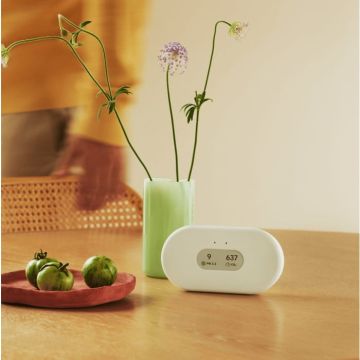
Using an indoor air quality monitor, such as the Airthings View Plus, helps you keep track of your indoor PM2.5 levels in real time to ensure you stay within healthy limits. The Airthings app has easy-to-read graphs to quickly show you your PM levels, with thresholds for good, fair, and poor.
- Good (<10 µg/m³): The air is clean and healthy.
- Fair (10–25 µg/m³): Keep monitoring. If PM levels remain here, try to identify the indoor source (like cooking) or check outdoor pollution levels.
- Poor (>25 µg/m³): Action is required. You need to ventilate or purify the air immediately.
Setting alerts when PM spikes is a great way to understand when to act to reduce levels. It also helps you understand what typical behaviors (for example, frying food) might be causing PM to rise.
Learn more about getting started with indoor air quality with our guide, How to test the indoor air quality inside your home.
Real-world examples of rising PM in the home
Just how dramatic can cooking-related PM spikes be? In a real-home test conducted by Wirecutter using an Airthings View Plus monitor, burning a single pancake with no ventilation caused PM2.5 to build up to nearly four times the level recorded when a range hood or window fan was running, and it lingered at unsafe levels for significantly longer.
How can I reduce particulate matter in my home?
You can’t control the air outside, but you can take simple steps to create safer and healthier air inside to protect you and your family from PM.
- Monitor your air: PM2.5 is invisible, so the only way to know if your cooking, ironing, or a distant wildfire is polluting your home is to use a smart indoor air quality monitor like the Airthings View Plus. It detects PM2.5, PM1, and other harmful pollutants in real time and sends you alerts via the app if PM levels are looking poor.
- Use a HEPA air purifier: When outdoor air is poor (such as during wildfire season, or if you live near a highway or industrial site), opening a window will only bring more PM inside. Instead, run an air purifier equipped with a True HEPA filter, like the Airthings Renew, which physically traps 99.97% of fine particles. Try to run air purifiers in the spaces you spend the most time, and monitor your air quality alongside this to check it’s effectively reducing PM levels.
- Ventilate when cooking: Always use the exhaust hood over your stove when cooking, and ensure it vents directly outside. If you don’t have a vented hood, open a window while searing, broiling, or frying on days when outdoor air quality is good.
- Vacuum smartly: Standard vacuuming can kick settled PM10 back into the air. Make sure your vacuum uses a HEPA filter to trap dust and dander rather than just recirculating it.
- Be mindful of indoor sources of smoke: Smoking indoors, burning candles, or using a fireplace all contribute to elevated PM in your home. If you must do these things, opening a window where possible or running an air purifier can help reduce levels. However, these things should all be avoided during an event like a wildfire, as they will cause an already poor air quality situation to significantly worsen.
Frequently Asked Questions (FAQ)
Can an air purifier remove PM2.5?
Yes, air purifiers equipped with True HEPA filters can effectively remove PM2.5 and PM1 particles. Ensure the purifier is properly sized for the room you are using it in.
Is PM2.5 worse than PM10?
Yes. While PM10 can irritate your throat and eyes, PM2.5 is much more dangerous because its small size allows it to bypass your body’s defenses, penetrating deep into your lung tissue and entering your bloodstream.
Does opening a window reduce particulate matter?
It depends entirely on the outdoor air quality. If your indoor PM is high from cooking and the outdoor air is clean, opening a window will flush the particles out. However, if there is smog or wildfire smoke outside, opening a window will severely worsen your indoor PM levels. Always check your local outdoor Air Quality Index (AQI) before ventilating.
How does PM harm my health?
Short term, exposure to high PM can mean a runny nose, coughing, and sneezing, and can cause severe flare-ups for individuals suffering from asthma or seasonal allergies.
What are the main sources of PM2.5 indoors?
The most common indoor sources of PM2.5 are cooking (especially frying and grilling), candles, incense, tobacco smoke, and wood-burning fireplaces. PM2.5 also enters from outdoors through gaps around windows, doors, and ventilation systems, particularly during wildfire events or high-traffic urban pollution. An indoor air quality monitor will show you exactly when and where your levels spike.
What is a safe level of PM2.5 indoors?
The WHO revised its PM2.5 guidelines in 2021, setting the recommended annual mean at 5 µg/m³, half of the previous limit, reflecting growing evidence of harm at lower exposures. For 24-hour periods, the WHO guideline is 15 µg/m³. As a general rule, keeping your indoor PM2.5 consistently below 10 µg/m³ is a reasonable target for a healthy home environment.
What is the difference between PM1, PM2.5 and PM10?
The number refers to the maximum diameter of the particle in micrometers (µm). PM10 includes all particles under 10 µm, roughly the width of a human hair. PM2.5 captures the finer fraction under 2.5 µm, which penetrates deeper into the lungs. PM1 is the finest category, under 1 µm, and is small enough to pass through lung tissue directly into the bloodstream. The smaller the particle, the deeper it travels and the greater the health risk.
Are children more vulnerable to particulate matter than adults?
Yes. Children breathe at a faster rate than adults, meaning they inhale a greater volume of air, and whatever is in it, relative to their body weight. Their respiratory and immune systems are also still developing, making them less equipped to handle sustained exposure. The WHO and EPA both identify children as a high-risk group for PM-related health effects, including reduced lung development and increased risk of respiratory illness.
Can I see or smell particulate matter?
Not reliably. Very dense smoke or smog may be visible, but most PM2.5 and PM1 concentrations that exceed safe thresholds are completely invisible and odorless. This is what makes particulate matter particularly hazardous; you can’t rely on smell, taste, or sight alone. The only accurate way to know your indoor PM levels is with a dedicated air quality monitor that measures particle concentrations in real time.
How long does PM2.5 stay in the air indoors?
Unlike larger particles that settle quickly onto surfaces, PM2.5 can remain suspended in indoor air for hours, sometimes days in a poorly ventilated space. This is because the particles are so light that normal air currents keep them aloft. Activities like walking across a room, opening a door, or running a fan can re-suspend particles that have settled, prolonging exposure. Continuous air purification and ventilation are the most effective ways to reduce dwell time.
Sources
- American Lung Association (State of the Air)
- US EPA (PM NAAQS / PM2.5 standard)
- US EPA (Particulate matter: the basics)
- US EPA (Particle pollution exposure)
- WHO (Air quality guideline / PM2.5)
- Harvard University (Office air quality may affect employees’ cognition, productivity)
- The LA Fire Health Study