How indoor air quality is ruining your sleep, and how to fix it
TL;DR: Poor bedroom air quality, driven by CO₂ buildup, humidity extremes, VOCs, and PM2.5 particles, can silently disrupt your sleep and cause morning grogginess. Fixes include monitoring your indoor air quality to pinpoint any issues, and increasing natural ventilation in your bedroom. Additionally, investing in an air purifier with a HEPA filter can help reduce particulate matter levels for clearer airways and less irritated eyes. Finally, paying attention to and keeping humidity and temperature in a healthy range (aim for between 40% and 50% humidity and a temperature of 65°F / 18°C) can also help you stay comfortable and contribute to a better night’s sleep.
If you wake up with a dry throat, a stuffy nose, or just feel exhaused and groggy, then your bedroom’s air quality might be to blame. We spend roughly one-third of our lives sleeping, meaning we spend more time breathing the air in our bedrooms than anywhere else. The air quality inside our bedrooms should, therefore, be something we address if we’re having issues getting quality sleep.
Sleep quality and the ability to fall and stay asleep can, of course, be disrupted by too much screen time, a bad mattress, stress, or late-night caffeine. However, one of the most critical factors for sleep hygiene is indoor air quality (IAQ). The IAQ in your bedroom dictates how deeply you sleep, how well your body recovers, and how energized you feel the next morning, and it’s often overlooked completely.
A study in the journal Sleep Health concluded that the “importance of the bedroom environment goes far beyond the mattress for high-quality sleep.” So, if you feel like you've tried everything but still aren't feeling well-rested, then monitoring a few things like CO2 and humidity could reveal that your bedroom's air quality was to blame all along.
What are the main air quality issues affecting sleep?
Buildup of carbon dioxide (CO₂), airborne pollutants like VOCs and PM, and the wrong temperature or humidity can all affect sleep. Modern US homes are built to be highly energy-efficient and airtight. While this keeps your heating and cooling bills low, it turns a closed bedroom into a trap for stale air and pollutants.
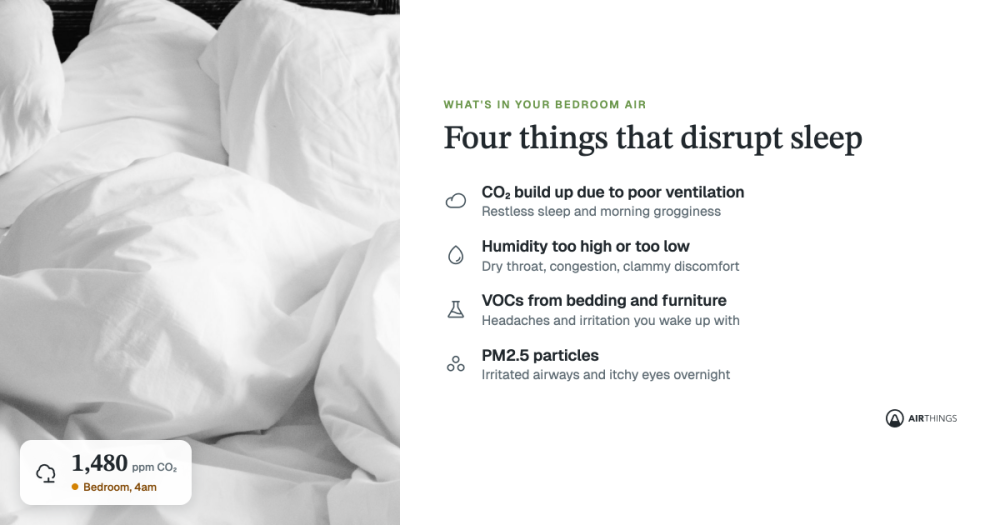
1. Carbon dioxide (CO₂) buildup
CO₂ is the number one destroyer of sleep quality. When you sleep with the bedroom door and windows closed, the carbon dioxide you exhale has nowhere to go.
Unsure what CO₂ is and where it comes from? Read our guide, What is carbon dioxide (CO₂), and what does CO₂ in my home mean for my health?
Research shows that CO₂ in a sealed bedroom can rise from around 420 ppm outdoors to 1,500–2,100 ppm, three to five times the normal outdoor level. Two occupants in a bedroom for 7–8 hours with a closed door and window means CO₂ levels can easily reach 3,000 ppm by morning.
The science proves it. A study published in the journal Indoor Air found that sleep quality decreased significantly with the increase of CO₂ concentration. People were monitored over 54 days. Both survey responses and physiological measurements showed that sleep quality worsened as CO₂ levels increased. At 3,000 ppm, overall sleep quality scores were about 19% lower than at 800 ppm.
The study also found that higher CO₂ levels were linked to:
- Longer time needed to fall asleep
- Less deep sleep (slow-wave sleep)
In the same sleep environment, men generally slept better than women, with:
- Higher sleep quality ratings
- More deep sleep
- Faster time falling asleep
The difference between men and women was statistically significant at 800 ppm CO₂.
When you breathe in highly concentrated CO₂ all night, your body has to work harder to absorb oxygen. This triggers your central nervous system, leading to:
- Micro-awakenings: You may not fully wake up, but your brain is pulled out of deep, restorative REM sleep.
- Morning grogginess: High CO₂ is the primary reason you can sleep for eight hours and still wake up feeling lethargic or dealing with a dull headache.
- Interaction with sleep apnea: For those with obstructive sleep apnea, sleeping in a room with high CO₂ (above 1,000 ppm) further stresses the body when it is already struggling to expel carbon dioxide and take in oxygen. This can trigger hypercapnia symptoms like morning headaches and daytime grogginess.
2. Humidity extremes
Your respiratory system relies on a delicate balance of moisture to function properly while you sleep. The EPA recommends indoor humidity between 30–50% year-round to limit mold growth and dust mite proliferation.
- Too dry (under 30% relative humidity): Winter heating systems strip moisture from the air. Breathing dry air all night parches your throat and nasal passages, leading to mouth-breathing, severe snoring, and an increased susceptibility to catching airborne winter viruses. Winter heating can cause indoor humidity to drop as low as 15%, especially in cold, dry climates — well below the threshold for comfortable breathing.
- Too humid (over 50% relative humidity): High humidity makes a room feel hot and stifling, preventing your core body temperature from dropping (a necessary trigger for sleep). Worse, humidity over 50% turns your mattress into a breeding ground for dust mites, a leading trigger for nighttime asthma and allergies. It might also mean ideal conditions for mold growth behind your headboard or wardrobe.
More on humidity and why it matters to your health here: What is indoor humidity? How moisture levels can affect your home and your health.
3. Particulate matter (PM2.5) and allergens
As you move around in bed, you kick up a microscopic cloud of dust, pet dander, and pollen that has settled on your blankets and floors. These fine particles (PM2.5) are inhaled deeply into your lungs, irritating your airways and causing your nasal passages to swell. How much PM2.5 ends up in your bedroom depends on where it comes from. With windows closed and no air cleaner running, the EPA estimates indoor PM2.5 during a wildfire smoke event sits at roughly 55% to 60% of outdoor levels, though that varies from 30% to 100% between homes. Indoor sources are the bigger risk: cooking on a gas stove, a wood fire, smoking, or pets can push bedroom PM2.5 well above what is outside.
If you frequently wake up with a stuffy nose or congestion that magically clears up an hour after you leave the bedroom, PM2.5 is likely to blame. For reference, the WHO’s updated 2021 air quality guidelines set the annual mean PM2.5 safe limit at 5 µg/m³ — half of the previous guideline, reflecting new evidence on health harms.
We have an in-depth guide on particulate matter here: What is particulate matter? A guide to PM1, PM2.5 and PM10 and how it affects our health.
How can I optimize my bedroom environment for sleep?
Creating the best sleeping environment starts with monitoring your air quality, increasing fresh air by opening a window or using mechanical ventilation, and using an air purifier. You do not need to overhaul your entire house to get a better night’s rest. Focus on controlling the micro-climate inside your bedroom.
Step 1: Monitor your bedroom air quality
The first step is placing a smart air quality monitor, like the Airthings Wave Enhance or the View Plus, on your nightstand. Because they track your air continuously, you can check up on your air quality data in the Airthings app the next morning and look at the exact moment your CO₂ spiked or your humidity plummeted during the night. This helps take the guesswork out of your sleep hygiene.
Learn how to get started with indoor air quality at: How to test the indoor air quality inside your home.
Step 2: Reduce CO₂ in your bedroom
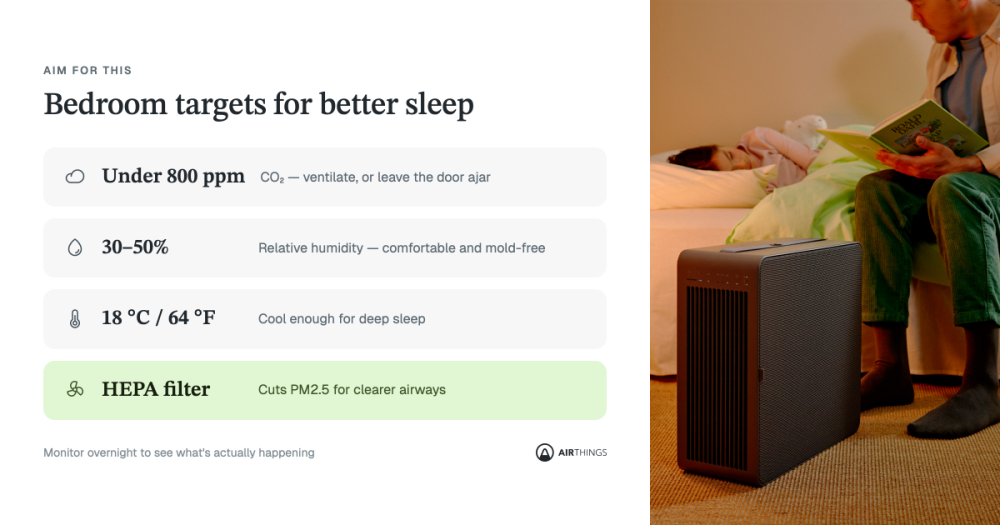
To keep your CO₂ levels in the ideal zone (under 800 ppm), you must introduce fresh air.
- The easy fix: Leave your bedroom door open a few inches to allow air to circulate with the rest of the house.
- The best fix: If the outdoor weather and air quality permit, crack your bedroom window just one inch. In a field study published in Indoor Air, researchers at the Technical University of Denmark found that opening a bedroom window dropped average overnight CO₂ from 2,585 ppm to 660 ppm — and that sleepers in the low-CO₂ condition slept measurably better and performed better on a logical reasoning test the next morning.
- The other option: If opening a window or door is problematic, make sure your HVAC system is bringing in fresh air. Another fix is to use mechanical ventilation from a bathroom exhaust. This can help pull stale air out and fresh air in.
Step 3: Use an air purifier to reduce PM
If you suffer from allergies, live in an area prone to wildfire smoke, or sleep with pets, a standard HVAC filter is not enough. Place a dedicated, ultra-quiet true HEPA air purifier, such as the Airthings Renew, in your bedroom. Run it on “Silent Mode” while you sleep to continuously scrub PM2.5, dust, and dander from the air without disrupting your rest.
Step 4: Balance your temperature and humidity
Sleep experts agree that the optimal bedroom temperature for adults is cool, around 65°F (18°C). A room temperature above 75°F (24°C) has been shown in polysomnography studies to reduce slow-wave (deep) sleep and increase wakefulness.
Pair this temperature with an indoor relative humidity of 40% to 50%. That is a tighter target than the EPA’s 30–50% whole-home range, because the bedroom is where dry airways and dust mites matter most. If your Airthings monitor shows your room is too dry, run a small humidifier. If it is too damp, rely on your home’s air conditioning or a small dehumidifier to pull the excess moisture out.
Why is good sleep quality so important?
Poor sleep doesn’t just leave you tired. The NIH links chronic sleep deprivation to increased risk of heart disease, stroke, obesity, and dementia. Sleep quality is as foundational to your health as diet and exercise.
The good news is that bedroom air quality is one of the most controllable factors in how well you sleep. The Airthings View Plus monitors CO₂, PM2.5, humidity, and four other key indicators, and delivers a sleep report to your app each morning so you can see exactly what happened in your bedroom overnight. Adjust, improve, repeat. Sleep better, live better.
Frequently Asked Questions (FAQ)
Why do I wake up with a stuffy nose every morning?
Morning congestion is usually caused by inhaling indoor allergens (like dust mites and pet dander) overnight, or by sleeping in a room with very low humidity, which dries out and irritates your nasal passages. Using a HEPA air purifier and monitoring your humidity can resolve this.
Should I sleep with my bedroom door open or closed?
For air quality purposes, it is highly recommended to sleep with the door open. A closed door traps the carbon dioxide you exhale, leading to stale air and morning grogginess. If you must sleep with the door closed for privacy or fire safety, ensure your home’s HVAC fan is running continuously to circulate the air, or crack a window.
Can a stuffy room cause nightmares?
While a stuffy room does not directly create the content of a nightmare, high levels of CO₂ and poor ventilation cause physical discomfort, elevated heart rates, and fragmented REM sleep.
Do indoor plants improve bedroom air quality?
While plants do absorb CO₂ and release oxygen, studies show you would need over 1,000 plants to meaningfully lower CO₂ in an average room. Rely on proper ventilation, not houseplants, for fresh air.
What is a safe CO₂ level for a bedroom?
CO₂ levels below 800 ppm are considered good for sleep quality. Levels between 800–1,000 ppm begin to impair cognitive function and sleep depth. Above 1,000 ppm, research published in the journal Indoor Air found measurable reductions in sleep efficiency and increased nighttime awakenings. Outdoor air sits at approximately 420 ppm for reference.
How does humidity affect sleep quality?
The ideal bedroom humidity for sleep is 40–50%. Below 30%, dry air irritates the mucous membranes in your nose and throat, increasing mouth-breathing and snoring. Above 50%, dust mite populations increase significantly — according to the American Academy of Allergy, Asthma & Immunology, dust mites thrive at humidity levels above 50% and are one of the most common triggers of nighttime allergic rhinitis.
What does PM2.5 do to your body while you sleep?
PM2.5 particles are small enough (under 2.5 micrometers) to bypass your nose and throat and lodge deep in your lungs. The EPA classifies PM2.5 as a criteria air pollutant because prolonged exposure is linked to inflammation of the airways, reduced lung function, and cardiovascular stress. During sleep, when your body is in recovery mode, this inflammation can disrupt breathing patterns and suppress immune function.
How do I know if my bedroom air quality is bad?
Common signs include waking up with a dry throat, nasal congestion that clears within an hour of leaving the bedroom, morning headaches, and persistent fatigue despite adequate sleep hours. However, many air quality problems — including elevated CO₂ and PM2.5 — are odorless and invisible. The only reliable way to know is continuous monitoring with a dedicated IAQ sensor.
Is an air purifier worth it for better sleep?
Yes, if you choose the right type. A True HEPA air purifier removes at least 99.97% of airborne particles 0.3 microns in diameter, according to the EPA — this includes dust mite allergens, pet dander, mold spores, and pollen. For bedrooms, look for a unit with a low noise rating (under 30 dB on sleep mode) so it runs all night without disrupting rest.
Does opening a window actually improve sleep?
Yes, and it has been measured. In a field study at the Technical University of Denmark, published in Indoor Air, students who slept with a bedroom window open averaged 660 ppm CO₂ overnight, compared with 2,585 ppm when the window stayed shut — roughly a 75% reduction. Movement data showed objectively better sleep quality in the low-CO₂ condition, and those sleepers reported less next-day sleepiness and better concentration, as well as scoring higher on a logical reasoning test the following morning. Separate research from the Harvard T.H. Chan School of Public Health found the same CO₂-and-ventilation effect on cognitive performance in daytime office environments. Even a 1-inch gap provides meaningful air exchange without significant noise or temperature disruption in most climates.
Sources
- Strøm-Tejsen et al., Indoor Air (2016) — The effects of bedroom air quality on sleep and next-day performance
- Indoor Air (Experimental study on sleep quality affected by carbon dioxide concentration)
- Sleep Health (The importance of the bedroom environment — beyond the mattress — for high-quality sleep)
- NIH (Sleep environment and CO₂)
- NIH News in Health (Good sleep for good health)
- Harvard T.H. Chan School of Public Health (Office air quality may affect employees’ cognition, productivity)
- US EPA (Strategies to reduce exposure indoors)
- Sleep Foundation (Best temperature for sleep)