What is indoor humidity? Ideal levels, and when it's too high
TL;DR: For most homes, indoor relative humidity should sit between 30% and 60% (the EPA recommends 30–50%). Above 60% is too high: your home is at risk of mold, dust mites, and structural damage, and at 70% or more you should act now. Below 30% is too dry, which helps airborne viruses survive and irritates skin, eyes, and throats. The colder your climate, the closer to 30% you should aim in winter. You can’t fix what you can’t measure, so a continuous air quality monitor is the only way to know where your levels actually stand. From there, the fixes are simpler than you’d think.
Indoor humidity refers to the moisture content in the air in your home. Humidity is the ultimate balancing act. If the air in your home is too damp, meaning too much moisture, you risk mold growth, which can cause serious respiratory issues, property damage, and severe allergy flare-ups. If the air is too dry, meaning too little moisture, you risk respiratory infections, and irritated skin, nose, throat, and eyes.
While we often check the outdoor humidity before leaving the house, indoor humidity has a much more profound impact on our daily lives. Below, you’ll find what your humidity reading means, what level to aim for, how moisture affects your home and your health, and how to get the balance right.
Is 60%, 65%, or 70% humidity too high in a house?
Yes, once indoor humidity regularly sits above 60%, it is too high for most homes. At 60–70%, mold and dust mites have the conditions they need to thrive, and condensation starts to form on cold windows and exterior walls. At 70% or above, the risk of mold and moisture damage is high and you should act straight away. Use the table below to see what your reading means.
| Indoor humidity | What it means | What to do |
|---|---|---|
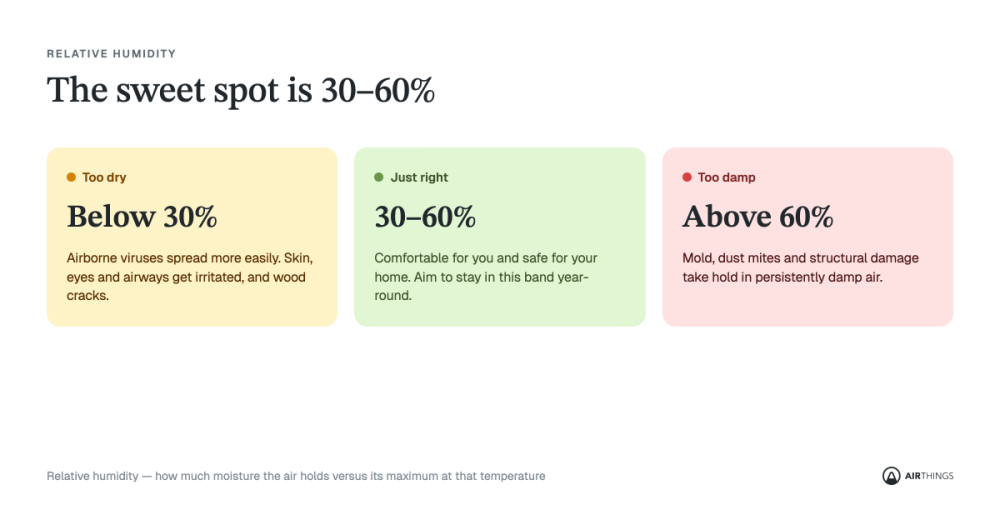
| Below 30% | Too dry. Airborne viruses survive longer; skin, eyes, and throat get irritated; wood can shrink and crack. | Add moisture: use a clean humidifier (with distilled water) or air-dry laundry indoors. |
| 30–50% | Ideal. This is the range the EPA recommends for indoor air. | Keep monitoring. In a cold winter, aim for the lower end. |
| 50–60% | Acceptable for most homes, but dust mites multiply faster above 50%, and cold surfaces may start to collect condensation. | Ventilate after showering and cooking. Watch windows and exterior walls for condensation. |
| 60–70% | Too high. Conditions favor mold, mildew, and dust mites, and paint and wood can start to suffer. | Find the moisture source, improve ventilation, and run a dehumidifier in damp rooms. |
| Above 70% | High risk. Sustained levels like this can lead to mold growth, wood rot, and structural damage. | Act now: dehumidify, check for leaks or water damage, and look for signs of mold. |
What is the right humidity level for a home?
To protect both your respiratory health and your property, the US Environmental Protection Agency (EPA) recommends keeping indoor relative humidity between 30% and 50%.
At Airthings, we consider 30% to 60% to be the comfort zone for most homes. Staying within this window keeps the air moist enough to keep your skin hydrated and reduce the survival of airborne viruses, but dry enough to discourage mold growth and dust mites.
Why the “right” number depends on where you live
You will see different upper limits quoted, and the difference is not an accident. Mold does not need the whole room to be humid; it needs roughly 80% relative humidity at a surface. In a cold climate, the inside face of an exterior wall or a window pane sits well below room temperature, so air at 50% in the middle of the room can reach saturation the moment it touches that glass. The colder it is outside, the lower your room humidity needs to be to avoid condensation.
That is why a home in New York in February and a home in Florida in August should not be aiming at the same number. In a cold snap, you may need to sit near the bottom of the range, closer to 30%, to keep windows and wall cavities dry. In a warm, humid climate the constraint is different: the risk is sustained dampness rather than condensation, and the practical job is holding the ceiling down.
This is why the thresholds on Airthings monitors are adjustable. Rather than being fixed to one global number, you can set the levels that suit your climate, your building, and your own comfort, and get alerts against those instead of a default that was never written for your house.
Know your number: Humidity changes hour to hour with the weather, showers, cooking, and heating, so a one-off reading won’t tell you much. A continuous monitor tracks it around the clock and alerts you when it drifts outside your range.
- View Plus: humidity alongside radon, PM2.5, CO₂, VOCs, and more, for main living spaces and bedrooms.
- Wave Enhance: tracks humidity and other key air quality factors in everyday living spaces.
- Corentium Home 2: our radon monitor, with a built-in humidity and temperature sensor, ideal for basements where damp and mold are common.
Not sure which is right for you? See how Airthings monitors compare.
What is humidity, and what is “relative” humidity?
Humidity is simply the measure of water vapor present in the air. Most of the time, when weather forecasters or smart monitors talk about moisture, they are referring to Relative Humidity (RH).
Relative humidity measures the amount of water currently in the air in relation to the maximum amount of water vapor the air can hold at its current temperature. It is expressed as a percentage. If the relative humidity reaches 100%, the air is completely saturated and cannot hold any more moisture, which results in condensation (or rain, outdoors).
How does temperature affect humidity?
Temperature and humidity are permanently linked. Warmer air can hold significantly more moisture than colder air. If you take cold winter air from outside (which holds very little water) and heat it up inside your home to 72°F (22°C), the absolute amount of water stays the same, but the relative humidity plummets because the warm air is now capable of holding much more moisture. This is why indoor air can feel so uncomfortably dry in the winter. Conversely, during the summer, hot, sticky outdoor air makes its way inside, forcing your air conditioner to work double-time to cool the air and strip the excess moisture out.
The dangers of high indoor humidity (>60%)
When your indoor relative humidity routinely creeps above 60%, the air starts to feel heavy and dense. High humidity usually stems from everyday activities like cooking, showering, and drying laundry indoors without proper ventilation.
1. Health impacts: mold, dust mites, and asthma
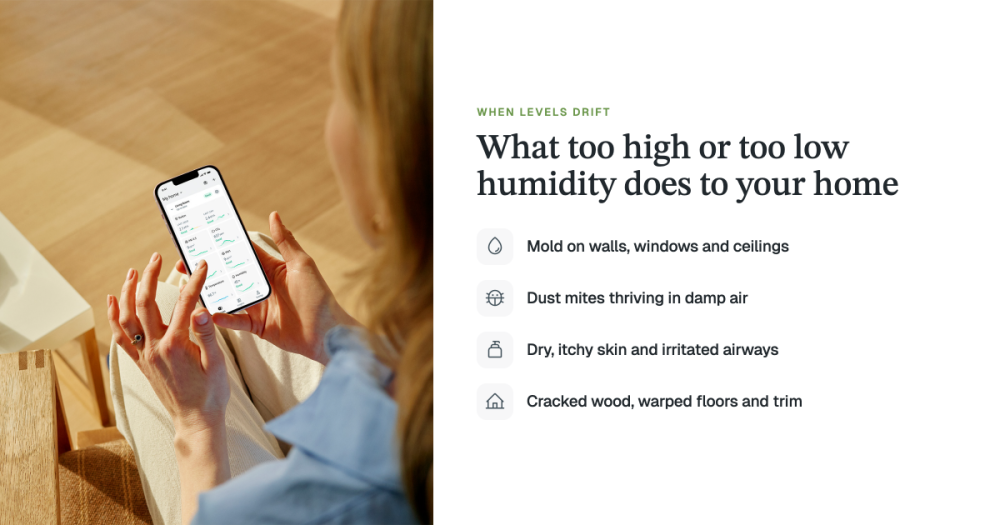
High humidity can create the conditions for a thriving ecosystem of biological pollutants.
- Dust mites: These microscopic pests are a leading trigger for asthma and allergies. Dust mites do not drink water; they absorb it directly from the air. They multiply rapidly when humidity exceeds 50%.
- Mold and mildew: According to the EPA, controlling moisture is the only effective way to control indoor mold. Higher humidity, coupled with the right temperature, creates ideal conditions for mold to thrive. Mold spores settle on damp surfaces (like bathroom walls or windowsills) and grow. Exposure to indoor mold is heavily linked to respiratory illness, chronic coughing, and the development of asthma in children.
What is black mold and is it dangerous?
“Black mold” usually refers to Stachybotrys chartarum, a dark greenish-black mold that can produce mycotoxins (toxic chemical compounds) under the right conditions. It is often singled out as uniquely hazardous, but the EPA’s position is that no indoor mold should be left to grow: the health effects of mold exposure vary from person to person, and the response is the same whichever species you are dealing with — find the moisture source and remove it. A strong, musty smell is a common early sign of mold growth, though it does not tell you which type you have.
As the EPA reports, young children are especially vulnerable to the health impacts of mold as their lungs and other organs are less developed than adults. They also breathe much faster than adults and take in more air, meaning they breathe in more of whatever is in the air around them. This can contribute to serious health problems, including respiratory illnesses, asthma, pneumonia, and other infections. In adults, it can cause skin rashes and contribute to respiratory illness and other serious health issues.
How does black mold form, and how do I remove it?
Black mold tends to grow in areas with constant moisture or water damage and appears as greenish-brown or black fuzzy growths on water-damaged wood or drywall. It often appears in places that have experienced flooding or persistent leaks, such as basements, crawl spaces, or areas affected by plumbing issues. Removing it requires careful cleaning, and if the problem is widespread, professional help should be sought.
2. Home damage: rot, peeling paint, and structural decay
If left unchecked, excess moisture will slowly destroy your home from the inside out.
- Condensation and paint: Warm, humid air naturally gravitates toward cooler surfaces, like exterior walls and glass windows. This constant condensation causes wallpaper to curl and paint to bubble and flake off.
- Wood rot: When wooden furniture, window frames, and hardwood floors absorb too much moisture from the air, they can swell and warp. Over time, persistent dampness can lead to deep structural rot in your home’s joists and foundations, resulting in thousands of dollars in repairs.
Why low humidity can damage our health and our home (below 30%)
Low humidity is most common during the winter months when central heating systems dry out the air. While it won’t cause mold, overly dry air is just as damaging.
An example from the Airthings offices: Most of the Airthings team is based in our Oslo office in Norway. During the winter months, Oslo’s climate can be very cold and very dry, meaning our office heating is working overtime. During a recent cold snap, we noticed our throats, skin on our hands, and lips feeling increasingly dry and chapped. Upon checking the air quality dashboard, we saw that humidity was frequently way below the ideal 30%.
1. Health impacts: airborne viruses and dry skin
-
Increased viral spread: Research from Stanford University (2024) found a link between low humidity and an increased survival rate of seasonal airborne viruses, such as COVID-19 or influenza. Institutions such as hospitals often increase ventilation to try and reduce the risk of virus transmission. However, this comes with the unintended effect of lowering humidity. Heating systems also tend to dry out air, further reducing relative humidity.
In dry winter air, respiratory droplets expelled during coughing or sneezing evaporate more quickly, allowing viruses like influenza and the common cold to remain suspended in the air longer and travel farther.
- Skin and eye irritation: Very dry air aggressively extracts moisture from your body. This leads to itchy, red eyes, chapped lips, and severe flare-ups of skin conditions like eczema and psoriasis. It also dries out the mucous membranes in your nose and throat, which reduces your body’s natural defenses and makes you more susceptible to infections.
2. Home damage: shrinking wood and static electricity
Just as wood swells in high humidity, it shrinks when deprived of moisture. Persistently dry air causes hardwood floors to separate, wooden musical instruments (like guitars and pianos) to crack, and wooden door frames to shift. Low humidity also increases static electricity, which can damage sensitive electronics.
Humidity also affects sleep quality
Health problems aside, the wrong humidity level can also affect our sleep. As the Sleep Foundation reports:
- High humidity can increase wakefulness and reduce the amount of time you spend in both slow-wave NREM and REM sleep. Both of these stages are crucial for your overall health and if affected, people may experience additional issues related to bodily recovery and memory consolidation.
- Low humidity affects comfort, causing a dry, scratchy throat and itchy skin, which also impacts sleep.
Read our guide on how to improve your indoor air quality for better sleep: How indoor air quality is ruining your sleep, and how to fix it.
How to fix and control indoor humidity
To understand if you have optimal humidity at home, a first step is to monitor your levels — you can’t fix the problem without knowing exactly what it is.
For main living spaces or bedrooms, a continuous air quality monitor, like View Plus or Wave Enhance, will track humidity 24/7 and alert you when your levels drift outside the range you have set. The default thresholds are below 30% and above 60%, and you can adjust both in the Airthings app to match your climate and your own preference. Our radon monitor, Corentium Home 2, also includes a humidity and temperature sensor, making it ideal for basements or lower living spaces where humidity and mold can pose issues. Humidity will fluctuate with the weather, season, and day-to-day household activities. Continuous monitoring helps establish a baseline and see if there’s a genuine issue.
Once you know your baseline humidity, you can use the following to help maintain optimum humidity:
How to reduce high humidity
- Ventilate: Always run the bathroom exhaust fan while showering and the kitchen range hood while boiling water. Opening a window alongside this (if possible) also helps.
- Dehumidify: Use a dedicated dehumidifier in notoriously damp areas, such as basements and crawl spaces. Ensure your HVAC system is properly sized; an oversized air conditioner will cool the house too quickly without running long enough to pull moisture out of the air.
- Change your behavior: Hanging wet laundry indoors can contribute hugely to humidity levels. If you have to dry laundry inside, crack open a window or run a dehumidifier in the room where your wet laundry is hanging. Close bathroom doors when taking a bath or shower, as the warm, wet air can enter other spaces and contribute to high humidity there too.
How to increase low humidity
- Use a humidifier: In the winter, use a portable or whole-house humidifier to add moisture back into the air. Ensure you clean it regularly to prevent bacteria from being pumped into your home.
- Passive moisture: As mentioned, habits can contribute to too-high humidity. However, doing the reverse and adopting these habits can also help increase humidity if it’s too low. So, try leaving the bathroom door open while you shower or air-drying your clothes indoors on a rack; these are simple, free, and sustainable ways to naturally boost humidity levels in dry winter months.
A note on humidifiers and high levels of particulates (PM)
It’s important to understand that fixing an issue like low humidity with an ultrasonic humidifier can inadvertently create other indoor air quality problems. The mist from humidifiers filled with tap water can result in extremely high levels of fine particulates (PM2.5), with levels affected across more of the home than just the room where the humidifier is standing, as this case from the American Lung Association shows, where a father discovered that PM2.5 levels in his son’s bedroom were equivalent to those caused by wildfire smoke.
These humidifiers can turn minerals found in tap water into tiny particles that can then be inhaled deep into the lungs. Using distilled or de-mineralized water in the humidifier instead of tap water can solve the problem. It’s also important to clean the humidifier regularly. Clean and dry the humidifier before storing it.
More advice and information about PM2.5 in the home can be found here: A guide to PM1, PM2.5 and PM10 and how it affects our health.
Frequently Asked Questions (FAQ)
Is 70% humidity too high in a house?
Yes. Indoor humidity of 70% or more is too high for any home. At this level, mold, mildew, and dust mites thrive, and condensation can soak into windows, walls, and wooden surfaces. If your home sits at 70% for more than short periods (such as straight after a shower), find the moisture source, improve ventilation, and run a dehumidifier until levels are back below 60%.
Is 60% or 65% humidity OK in a house?
60% is the upper limit of the healthy range for most homes, and 65% is above it. Short spikes after cooking or showering are normal, but if your home stays at 60–65% for long periods, conditions start to favor mold and dust mites. In a cold climate, aim lower still in winter, as cold windows and exterior walls can collect condensation even at 50–60%.
What humidity level causes mold?
Mold needs moisture at a surface rather than in the whole room: roughly 80% relative humidity where the air meets a wall, window, or floor. That can happen even when your room reading is lower, because cold surfaces cool the air next to them and push its humidity up. Keeping room humidity below 60% (and lower in cold weather) is the most reliable way to keep those surfaces dry.
What is a healthy indoor humidity level?
The EPA recommends keeping indoor relative humidity between 30% and 50% year-round, and 30% to 60% works well for most homes. Below 30%, the air becomes dry enough to irritate your respiratory system and skin. Toward the top of the range, conditions become more favorable for mold growth, dust mite proliferation, and structural moisture damage — how close to 60% you can safely sit depends on your climate and how cold your wall and window surfaces get. In a cold winter, aim lower.
What causes high humidity indoors?
The most common sources of excess indoor moisture are cooking, showering, doing laundry, and simply breathing. A family of four generates several liters of moisture per day just through normal activity. Poor ventilation traps this moisture indoors. In warmer climates, humid outdoor air seeping in through gaps and ventilation systems is also a significant contributor. Identifying the source is the first step to controlling it.
What are the signs of low humidity in a home?
Dry, itchy skin and eyes, frequent static electricity, cracked wooden furniture or flooring, peeling wallpaper, and persistent dry throats or nosebleeds are all common signs that your indoor humidity has dropped too low. In winter, central heating systems are the primary culprit, stripping moisture from the air as they warm it.
What is the best indoor humidity level for sleeping?
The ideal humidity for a bedroom is between 40% and 50%. This range keeps your nasal passages comfortably lubricated to prevent snoring and dry throats, while remaining low enough to prevent night sweats and dust mite proliferation.
Should indoor humidity be different in different climates?
Yes. Mold forms where air meets a cold surface, so the colder your climate, the lower your indoor humidity needs to be to keep windows and exterior walls dry. A home in a northern winter may need to sit near 30%, while a home in a warm, humid climate is working to hold levels down rather than up. This is why Airthings monitors let you adjust the humidity thresholds rather than alerting against a single fixed number — you can set the range that fits your climate and your home, and get notified against that.
Does humidity affect how hot a room feels?
Yes, significantly. High humidity slows the evaporation of sweat from your skin, which is your body’s primary cooling mechanism. This is why a humid room at 75°F (24°C) can feel far more oppressive than a dry room at the same temperature. For sleep in particular, this matters; your body needs to drop its core temperature to initiate deep sleep, and a humid bedroom actively works against that process.
How do I measure humidity in my home?
A smart indoor air quality monitor like the Airthings View Plus or Wave Enhance is a great way to track humidity levels. Unlike a single spot reading, a continuous monitor tracks how your humidity fluctuates throughout the day and night, showing you exactly when levels creep too high after a shower or drop too low on a cold winter night, so you can act before it becomes a problem. Read our guide on how to test indoor air quality at home for more information.
Can high humidity make you sick?
Not directly, but it creates conditions that do. Sustained humidity toward the top of the range accelerates mold and mildew growth, both of which release spores that trigger allergic reactions, asthma flare-ups, and respiratory infections. High humidity also allows dust mite populations to thrive; their waste particles are one of the most common indoor allergens. People with asthma, allergies, or compromised immune systems are particularly vulnerable.
Does a humidifier help with a cough?
Yes. If your cough is caused by dry air irritating your throat and airways, running a humidifier can soothe your respiratory system and loosen congestion. However, if your home’s humidity is already in the upper part of the healthy range, adding more moisture will not help and may encourage mold growth.
Will opening windows reduce indoor humidity?
It depends entirely on the outdoor weather. If the air outside is cool and dry, opening a window will effectively flush out indoor moisture. If it is hot and humid outside, opening a window will drastically increase your indoor humidity. Always check your local weather and your Airthings monitor before ventilating.
Can humidity damage my home?
Sustained high humidity causes serious structural damage over time. Excess moisture warps wooden floors and furniture, causes paint to bubble and peel, promotes rust on metal fixtures, and, most seriously, creates the conditions for mold to grow inside walls, under flooring, and in ceiling cavities. The EPA notes that mold can begin to develop on surfaces within 24 to 48 hours of moisture exposure, making persistent humidity a genuine structural and health risk.
Sources
- US EPA (Mold & humidity guidance / 30–50% RH)
- US EPA (A brief guide to mold, moisture and your home)
- US EPA (Mold exposure and respiratory conditions in young children)
- Stanford University (How low humidity could be a boon for viruses)
- NIH (Absolute humidity & airborne virus survival)
- US EPA (Care for your air: a guide to indoor air quality)
- American Lung Association (Is your humidifier putting your health at risk?)