What are volatile organic compounds (VOCs)?
TL;DR: VOCs (volatile organic compounds) are airborne chemicals that come from the “off-gassing” of things like paints, furniture, cleaning products, and even plastic children’s toys. Imagine the “new car smell” or the scent of a freshly painted room. These smells are often associated with newness or cleanliness, but they are actually the result of many different chemicals within these products and materials off-gassing.
In modern, energy-efficient homes, these gases become trapped indoors. According to the US Environmental Protection Agency (EPA), levels of VOCs are consistently two to five times higher indoors than outdoors [1]. Because we spend the vast majority of our time inside, understanding what these chemicals are and how they affect your body is critical for long-term health.
What are VOCs made of?
VOCs are a diverse group of carbon-based chemicals that “volatilize” (turn into gas) at room temperature. They are not one single pollutant, but rather a category of thousands of different chemicals found in everything from building materials to household cleaners.
Because they exist as gases, they are easily inhaled. Some VOCs have a distinct odor, like the smell of gasoline or ammonia, but many of the most dangerous VOCs are completely odorless, making them impossible to detect without specialized sensors.
Why do I need to monitor VOCs?
Some of the most harmful VOCs have no scent at all, meaning you need to monitor for them. You can also become used to scents in your home. The human nose is an incredible tool, but it has a fatal flaw: sensory adaptation. You eventually become “nose-blind” to the scents in your own home. This is why VOCs are one of the most difficult pollutants to manage without technology.
Are all VOCs dangerous?
Some VOCs, such as the ethanol and acetone produced by plants, won’t cause serious health risks, but they will contribute to overall VOC levels. However, other VOCs, like benzene, are extremely dangerous. No specific WHO guideline value has been developed for benzene in air. Benzene is carcinogenic to humans and no safe level of exposure can be recommended.
How are VOCs measured?
The term “VOCs” contains a large group of different gases. As the air inside a home is a constantly changing mixture of gases, measuring every single VOC would be extremely difficult to do, so most air quality monitors, such as the Airthings View Plus, Wave Plus, and Wave Enhance, estimate the total overall “TVOCs”, or “total volatile organic compounds”.
Read more about indoor air quality monitoring in our guide, How to test the indoor air quality inside your home.
What are TVOCs?
Rather than identifying every chemical separately, TVOC provides an overall indication of indoor air pollution from volatile compounds. So rather than monitoring for one particular VOC, your air quality monitor will give you an indication of the total amount of all these VOCs in your air. For most households, tracking changes and trends in TVOC levels is more useful than identifying every chemical individually.
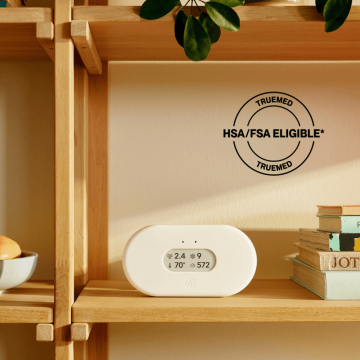
Airthings indoor air quality monitors like the View Plus, Wave Enhance, and Wave Plus use advanced Metal Oxide Semiconductor (MOS) sensors to detect TVOCs. Instead of guessing if a new sofa or a cleaning product is polluting your air, you can set the display to show your VOC level in real time, and also view a detailed graph on your phone. You can also set your own thresholds and receive an alert each time that is exceeded. Airthings measures TVOCs in “ppb” (parts per billion).
VOC levels overview
- 0–250 ppb: “Good”: Your air is clean. The View Plus or Wave Enhance indicator light will flash green.
- 250–2,000 ppb: “Fair”: Levels are rising; consider opening a window. The View Plus or Wave Enhance indicator light will flash yellow.
- Above 2,000 ppb: “High”: VOC levels are unsafe, action is required to identify the source and ventilate. The View Plus or Wave Enhance indicator light will flash red.
What are common sources of VOCs in your home?
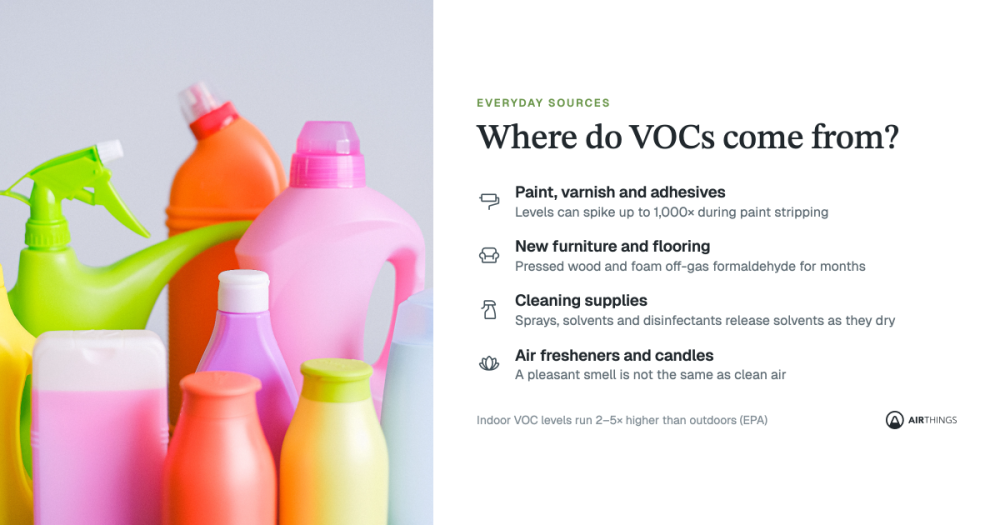
VOCs are found in almost every room of a typical US household, and levels indoors are often far higher than outdoors. As the EPA reports, levels of several organic compounds are often on average two to five times higher inside. For example, during and for several hours immediately after certain activities, such as paint stripping, levels of VOCs may be 1,000 times the background outdoor levels.
Causes of VOCs generally fall into three categories:
1. Building materials and furnishings: slow off-gassers
These items release VOCs slowly over months or years. This process is called “off-gassing.”
- Pressed wood products: Formaldehyde is commonly found in the glues used for particleboard, plywood, and fiberboard (MDF) in flat-pack furniture.
- Flooring and carpet: New carpets and vinyl flooring can release a cocktail of chemicals for weeks after installation.
- Paints and adhesives: Even after paint is dry to the touch, it can continue to emit low levels of vapors.
2. Household products: instant spikers
These items cause immediate, high-level spikes in your indoor VOC concentration.
- Cleaning supplies: Bleach, glass cleaners, and aerosol disinfectants.
- Personal care: Hairspray, perfumes, and nail polish remover.
- Aerosols: Air fresheners and “plug-in” scents.
3. Combustion and lifestyle: habit contributors
- Smoking, some candles, and vaping: These all release high concentrations of toxic VOCs, including benzene.
- Cooking: Heating oils and fats to high temperatures releases airborne chemicals.
- Hobbies: Glues, paints, permanent markers, and photographic solutions.
- People: People actually release a number of gases, which will show as VOCs, especially if alcohol has been consumed or certain foods eaten.
How do VOCs affect my health?
As the American Lung Association (ALA) explains, VOCs in your home can impact you in a number of ways, from the short term (headaches, respiratory irritation, nausea) to the long term (serious organ damage and even cancer). The health effects of VOCs depend on the specific chemical, the concentration in the air, and how long you breathe it in.
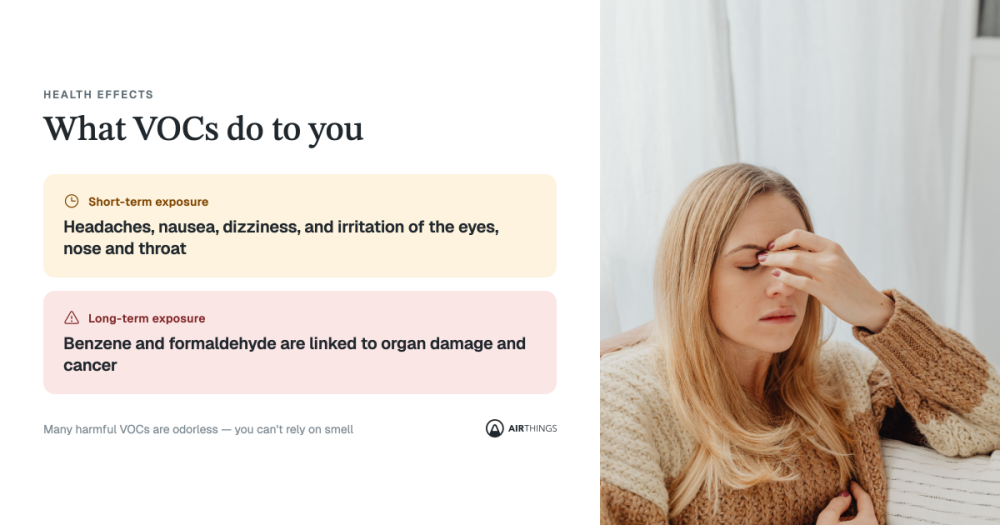
Short-term (acute) effects of VOC exposure:
When VOC levels spike, for example while you are deep-cleaning a bathroom or painting a room, you may experience:
- Eye, nose, and throat irritation
- Persistent headaches or dizziness
- Nausea
- Worsening of asthma symptoms
Long-term (chronic) effects:
Consistent exposure to even low levels of certain VOCs over many years can lead to serious health complications:
- Damage to the liver, kidneys, and central nervous system.
- Increased risk of cancer (specifically from chemicals like formaldehyde and benzene).
- Respiratory disease and chronic “Sick Building Syndrome”.
How do I lower VOCs in my home?
While it’s hard to eliminate every chemical, you can drastically reduce your “toxic load” using ventilation, choices over products and/or behavior, and air purification:
- Control the source: Choose “Low-VOC” or “Zero-VOC” paints and GREENGUARD-certified furniture. Avoid artificial fragrances and air fresheners. If you do buy new furniture, rugs, carpets etc, try to leave them somewhere well-ventilated so that they can “off-gas” before moving into your main living space or bedroom.
- Ventilation: Use your kitchen and bathroom exhaust fans, and open windows during and after using any chemical products.
- Air purification: Ensure your air purifier has a thick activated carbon filter. Standard HEPA filters do not capture VOCs; only carbon can chemically bond with and remove these gases from the air.
- Monitor: Track the effects of all the changes above with an indoor air quality monitor that measures VOCs, that way you’ll know that your actions have worked and that your air is safe and healthy.
Read our guide on how to reduce VOCs in your home for more details.
Frequently Asked Questions (FAQ)
Are VOCs dangerous for babies?
Yes. Infants and children breathe more air per pound of body weight than adults, and their organs are still developing. High VOC exposure is linked to an increased risk of childhood asthma and respiratory infections.
How long does it take for VOCs to go away?
It depends on the source. A burst of hairspray might dissipate in an hour with good ventilation, but a new memory foam mattress or MDF dresser can continue to off-gas for six months to a year.
Does an air purifier get rid of VOCs?
Only if it contains a high-quality activated carbon filter, like the Airthings Renew. Standard HEPA filters are designed to catch dust and particles, but VOC gases pass right through them.
What is a safe level of VOCs?
Because “Total VOCs” is a mixture of many chemicals, there is no single health-based standard. However, Airthings and many health organizations recommend keeping TVOC levels below 250 ppb (parts per billion) for optimal health and comfort.
Can plants help reduce VOCs?
In theory, some plants should be able to help absorb some VOCs, but their effect is unfortunately negligible. According to one academic study, you would need over 600 plants to help improve your air and even then, ventilation would still be more effective at reducing VOCs.
Are VOCs worse in summer or winter?
VOC levels can vary according to how you’re using your home. In winter, we’re more likely to keep our windows and doors closed, use a fireplace, run our heating, and even light candles — all things that contribute to VOC levels. In summer, natural ventilation increases, meaning lower VOCs indoors. Monitoring is the best way to know when levels are high and when to act.
What is the difference between “VOC” and formaldehyde?
VOCs are a broad category of a vast number of different chemicals. Formaldehyde is a specific VOC and is particularly well known as it’s one of the few indoor air pollutants that can be readily measured. As the American Cancer Society explains, common sources include pressed-wood materials, tobacco smoke, unvented fuel-burning appliances (like gas stoves), and certain cosmetics. It is also present in small amounts in some foods and the human body.
Are VOCs in new furniture dangerous?
Yes, especially if your living space is poorly ventilated. This will enable VOC levels to build up. If you have a room packed with new furniture and bad ventilation, the VOC levels will become unsafe. If you’re buying brand-new furniture, look for items that are specifically low-VOC, or ensure you leave your new item in a space that is well-ventilated for a few days before bringing it into your home.
How do I know if VOCs are making me sick?
The short term, “acute”, symptoms of exposure to high VOC levels in your home are a headache, nausea, sore throat, sore eyes, brain fog, and fatigue. If these things disappear when you’re outside and in fresh air, then it’s likely that your air quality, specifically high VOC levels, are to blame. If you already suffer from underlying respiratory conditions like asthma, you might also see worsening symptoms.
Do VOCs harm pets as well as people?
Yes, your pet can be severely affected by VOCs. Like humans, VOCs can also trigger allergies, respiratory symptoms, skin issues, nausea and headaches in pets. Be mindful when using cleaning products or purchasing new furniture — your pet can be affected too, so ensure the space they spend time in is well ventilated.
Sources
- US Environmental Protection Agency (EPA): Volatile Organic Compounds’ Impact on Indoor Air Quality
- National Institute of Environmental Health Sciences (NIEHS): Volatile Organic Compounds
- American Lung Association: Volatile Organic Compounds
- US EPA: Technical Overview of Volatile Organic Compounds
- World Health Organization: Benzene
- American Cancer Society: Formaldehyde
- American Lung Association: Volatile organic compounds at home
- Cummings & Waring (2019): Potted plants do not improve indoor air quality