What is radon? Safe radon levels, testing, and what to do
TL;DR: Radon is an invisible, odorless radioactive gas that comes from uranium breaking down in the ground. It enters homes through cracks in foundations and gaps around pipes, and long-term exposure to elevated levels can cause lung cancer. In the US, radon is measured in picocuries per liter (pCi/L); elsewhere it’s measured in becquerels per cubic meter (Bq/m³). No level of radon is completely safe, but the EPA recommends fixing your home if your long-term average is 4.0 pCi/L (150 Bq/m³) or higher, and considering it between 2.0 and 4.0 pCi/L. You can’t see, smell, or taste radon, so testing is the only way to know your level, and continuous monitoring shows your true long-term average.
What is radon gas?
Radon is a naturally occurring radioactive gas that comes from the breakdown of uranium in rocks and soil. You cannot see, smell, or taste radon, so a radon detector or monitor is the only way to know if it's in your home. Radon is the leading cause of lung cancer among non-smokers and the second leading cause overall, responsible for about 21,000 lung cancer deaths in the US every year (Source: EPA).
Any home can have high radon, whether it has a basement, a crawlspace, or is built on a slab. Rest assured, though, that while high radon levels in your home can feel daunting and alarming, lowering them with either DIY fixes or professional mitigation is straightforward and usually permanent.
Below, you’ll find a radon levels chart showing what’s safe and when to act, how to test and read your results, where radon comes from, and how to lower it.
Radon levels chart: what are safe radon levels?
Radon is a carcinogen, and there is no completely safe level of radon exposure, so health experts recommend keeping levels as low as is practically possible. The US Environmental Protection Agency (EPA) has set clear guidelines to help homeowners understand their risk and know when to take action. The average indoor radon level in US homes is about 1.3 pCi/L (Source: EPA).
| Radon level (pCi/L) | Radon level (Bq/m³) | What it means | What to do |
|---|---|---|---|
| Under 2.0 | Under 75 | Lower risk. No level is risk-free, but this is close to the US average. | Keep monitoring, as levels change with the seasons. |
| 2.0–4.0 | 75–150 | Moderate risk. The EPA recommends considering fixing your home, especially if you spend a lot of time on the lowest floor. | Try simple DIY fixes and keep monitoring your long-term average. |
| 4.0 and above | 150 and above | High risk. This is the EPA Action Level. | The EPA recommends fixing your home. Contact a certified radon mitigation professional. |
To put these numbers into perspective, living in a home with a radon level of 4.0 pCi/L exposes you to the same amount of radiation as getting 200 chest X-rays every year, or smoking 8 cigarettes a day (Source: Clinical and Translational Oncology: An overview on the relationship between residential radon and lung cancer: what we know and future research, Ruano Ravina et al, 2023).
Outside the US, guidelines differ. Health Canada recommends taking action when the average annual radon concentration exceeds 200 Bq/m³ in the normal occupancy area. The World Health Organization (WHO) recommends a reference level of 100 Bq/m³, if possible.
How is radon measured? Converting pCi/L and Bq/m³
In the United States, radon is measured in picocuries per liter of air (pCi/L). A picocurie is a unit of radioactivity that measures how many radioactive decay events occur in one liter of air. Outside the US, radon is measured in becquerels per cubic meter (Bq/m³).
1 pCi/L = 37 Bq/m³. To convert Bq/m³ to pCi/L, divide by 37. For example, 100 Bq/m³ is about 2.7 pCi/L, and 200 Bq/m³ is about 5.4 pCi/L.
It’s also important to note that radon can vary enormously from house to house, and street to street. The only way to know your home’s level is to test. To gain some idea of the varying levels in your region, Airthings’ radon map pulls data from connected radon devices to give a rough idea of your neighborhood’s radon level. Try checking radon levels in your area with the Airthings radon map.
Find out your home’s radon level
Radon changes day to day and season to season. A continuous digital monitor shows your real long-term average, so you know whether you need to act.
Corentium Home 2
Easy, accurate radon monitoring for basements and lower floors, with temperature and humidity.
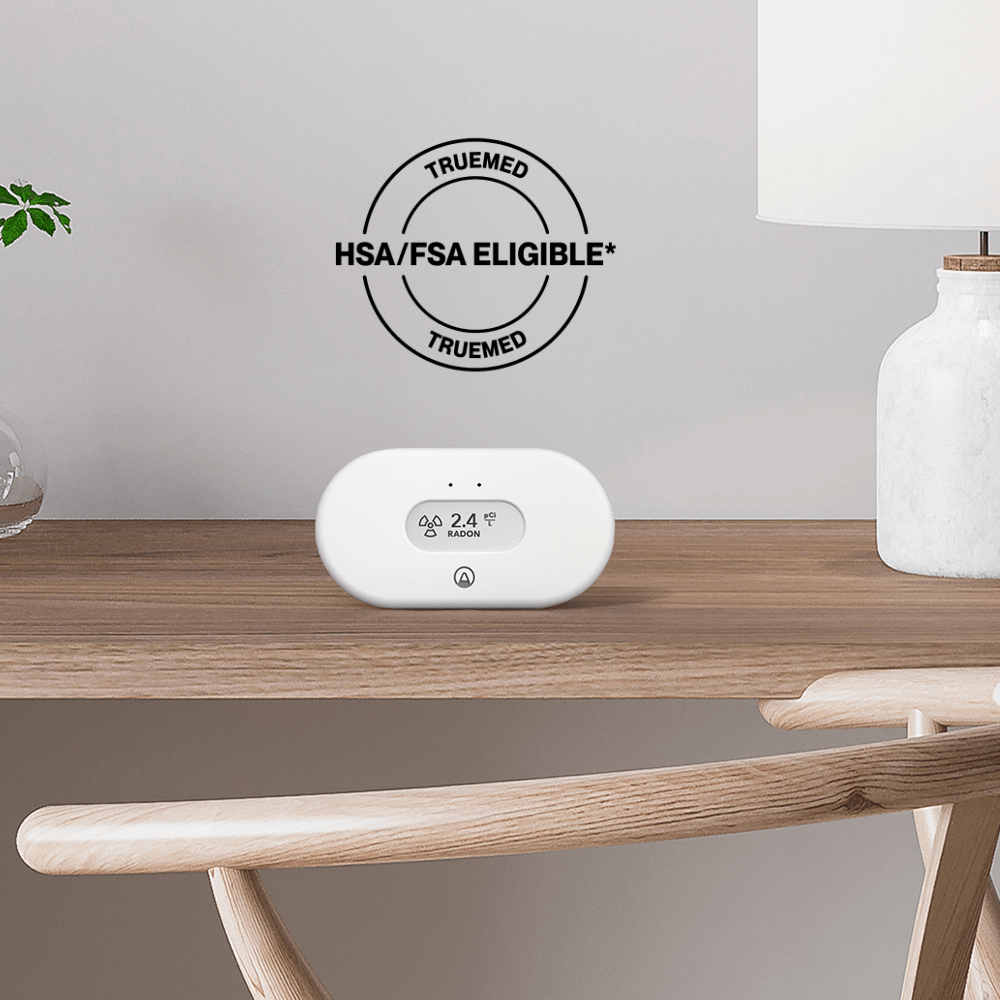
View Radon
Smart radon monitor for the basement or ground floor, with remote access to your readings.
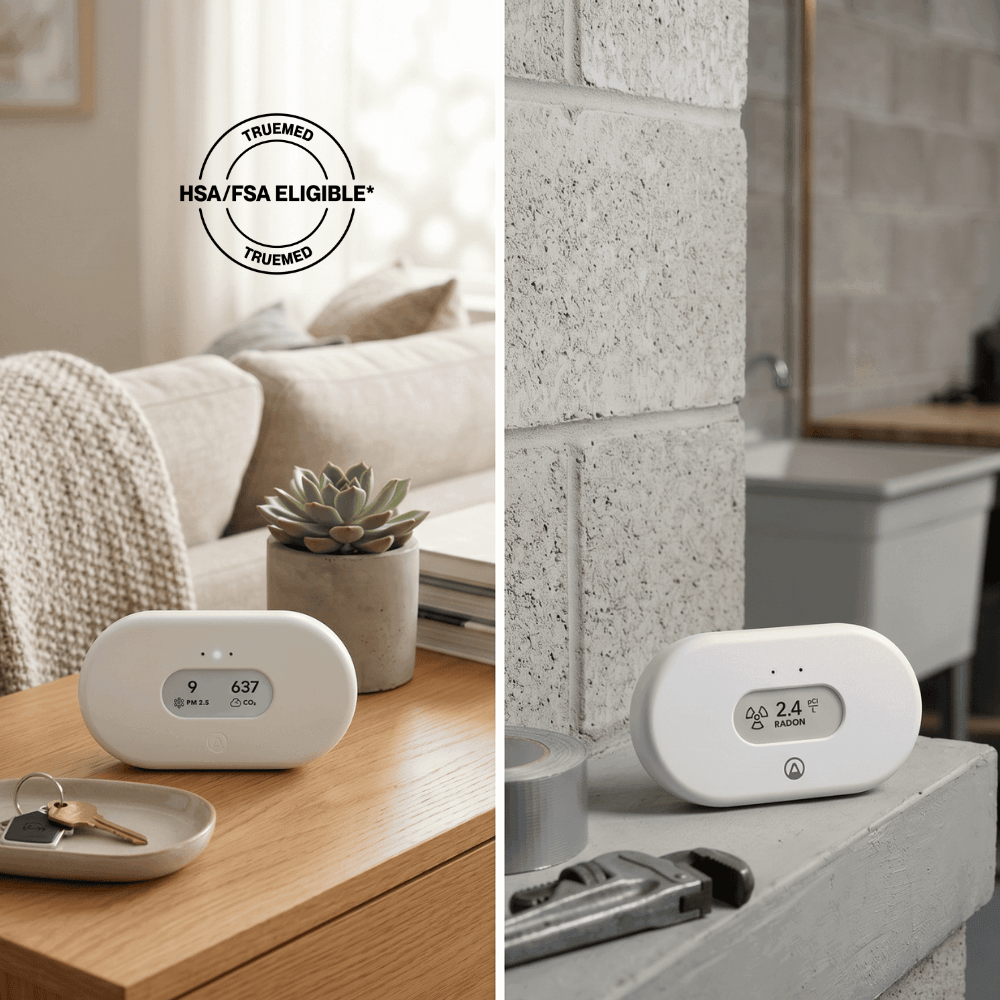
Living Room + Basement
View Radon for the basement plus View Plus for complete air quality in your main living space.
How to test and monitor radon in your home
Radon levels fluctuate from day to day, season to season, and even according to how you use your home. The same home might test low in the summer when the windows are open, but spike dangerously high in the winter when the house is sealed tight and the heating system alters the indoor air pressure.
Because of these fluctuations, a one-time, short-term radon test kit often fails to show the true picture. The EPA recommends long-term testing to fully understand your home’s average radon exposure. This long-term monitoring gives a broader, more accurate picture and will help you decide if you do indeed need to take action to lower your home’s radon levels.
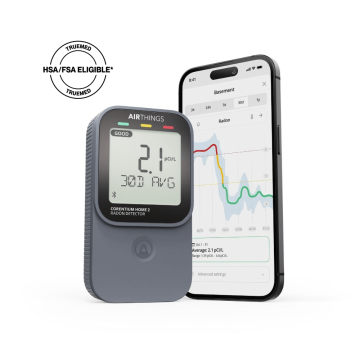
Using a continuous, digital radon monitor, such as the Airthings Corentium Home 2 or View Plus, is a simple way to understand your radon levels and protect your family.
Read our guide, How to test for radon, for more details on how to test your home.
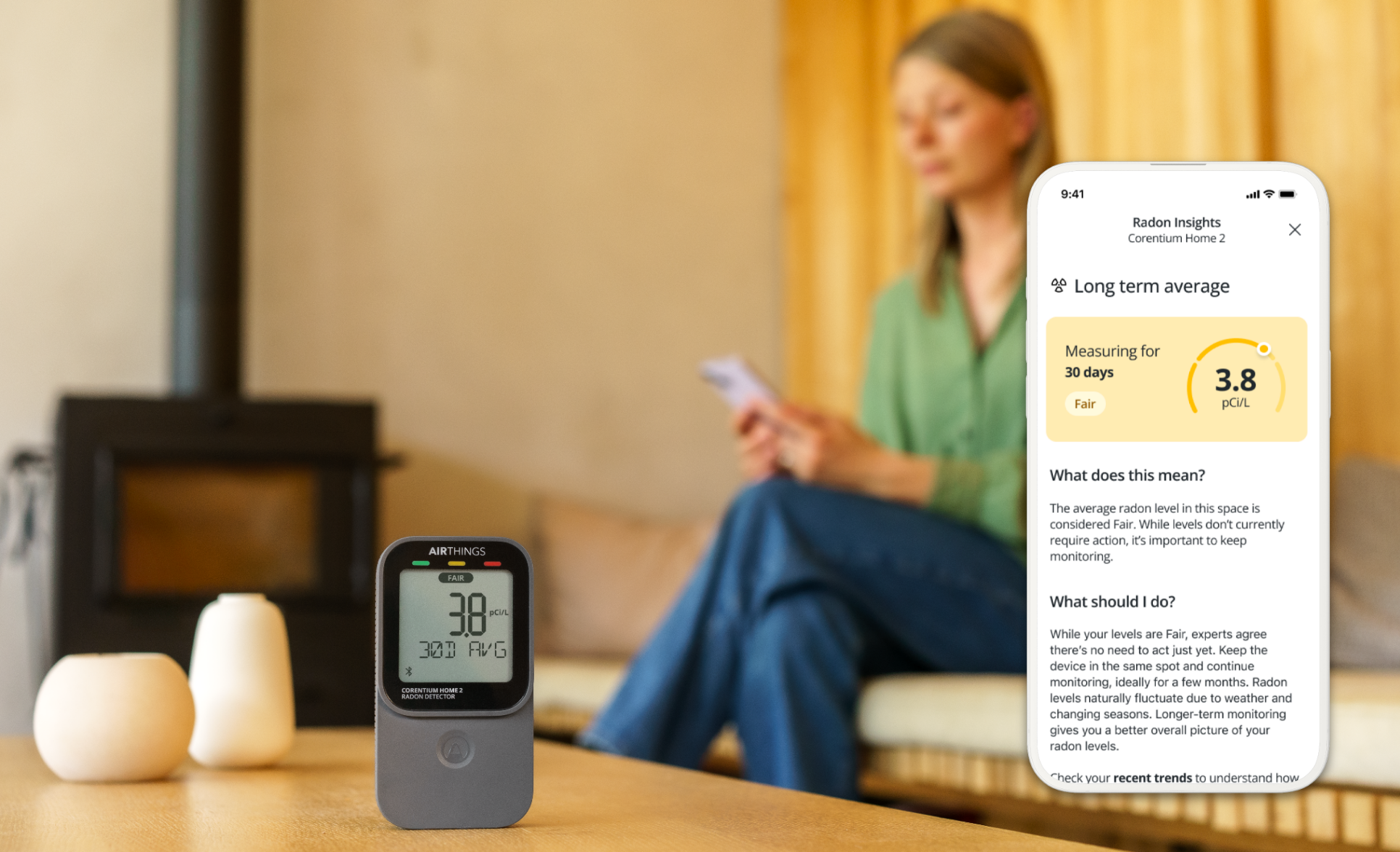
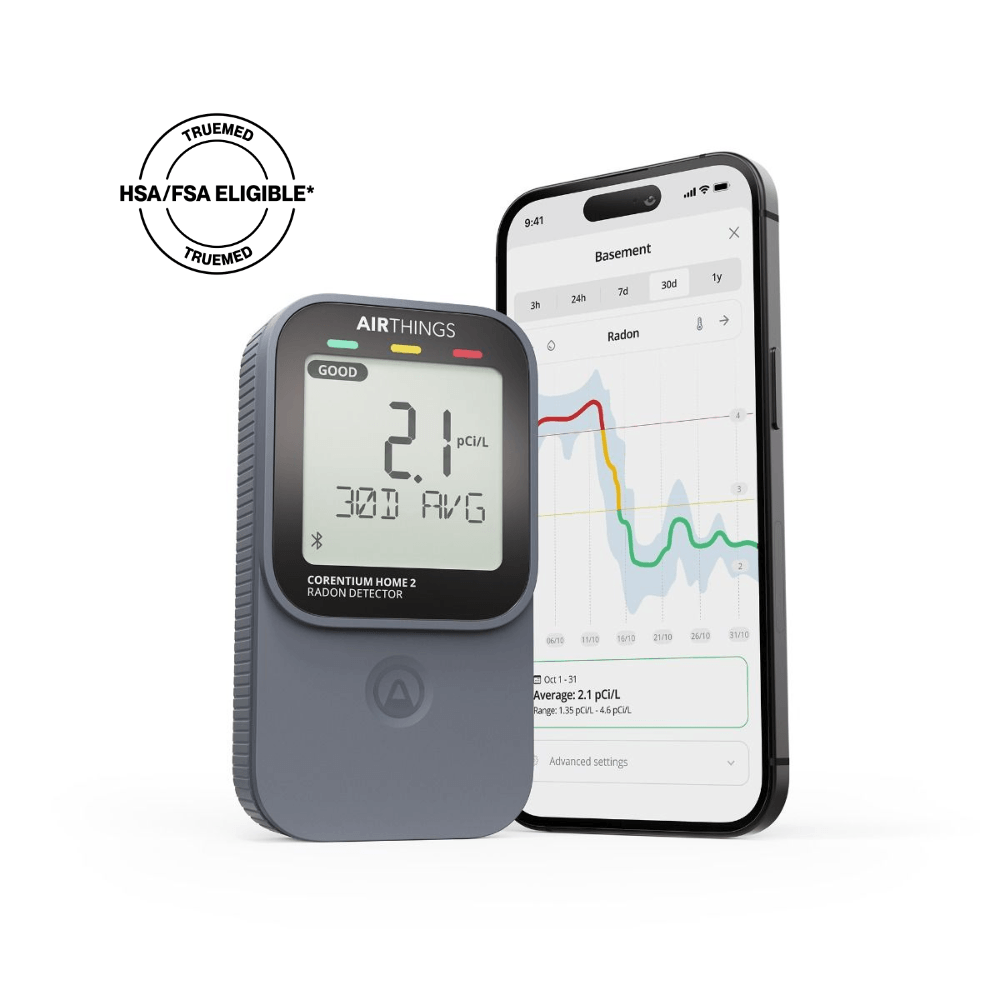
- For continuous radon monitoring: The Airthings Corentium Home 2 provides accurate, long-term daily, weekly, and continuous averages so you can see exactly how your home breathes over time. To see your radon data in more detail and to look back at levels over time, the Corentium Home 2 connects to the Airthings app. The “Radon Insights” feature guides you through the monitoring process, helps you understand what your radon levels mean, and tells you whether you need to take any action. The Corentium Home 2 has bonus sensors for temperature and humidity, making it ideal for keeping on top of your overall air quality.
- For the complete air quality picture: The Airthings View Plus monitors radon alongside particulate matter (PM), volatile organic compounds (VOCs), CO₂, temperature and humidity, making it ideal for keeping track of radon and general air quality in your main living spaces. Deeper insights into all these air quality factors are available in the Airthings app, alongside Radon Insights.
How to read your radon test results
Short-term readings (over a day or a week) can swing up and down with the weather, ventilation, and the seasons, so don’t act on a single high or low reading. Decisions should be based on your long-term average, ideally over several months. Compare that average to the radon levels chart above: below 2.0 pCi/L, keep monitoring; between 2.0 and 4.0 pCi/L, consider fixing your home; at 4.0 pCi/L or higher, the EPA recommends fixing it. With an Airthings monitor, the Radon Insights feature in the app explains what your readings mean and whether you need to take action.
CNET’s Smart Home editor Tyler Lacoma tested the Corentium Home 2 and recommended it as one of the best ways to assess radon levels at home, praising its simplicity and the addition of temperature and humidity sensors. Read the article on CNET: “I set my radon worries to rest with a gadget that puts testing kits to shame”
Where does radon come from?
Radon originates from the Earth’s crust. As natural uranium deposits in soil, rock, and water slowly decay, they release radon gas. Radon is found everywhere at some level. Outdoors, the gas disperses into the atmosphere and stays at low levels.
The danger begins when this radioactive gas rises from the soil and reaches a building's foundation. Because the air pressure inside a home is usually lower than the pressure in the soil surrounding the foundation, and radon is a gas that will always take the "path of least resistance," your house acts like a giant vacuum that draws radon upwards. Radon can be actively pulled inside through:
- Microscopic cracks in solid concrete floors and walls
- Construction joints and gaps around service pipes
- Crawlspaces and exposed dirt floors
- Sump pumps and well water
Today’s homes tend to be better insulated and more airtight to help conserve heat and save energy. However, this also means that it’s much easier for radon gas to build up indoors. Once trapped inside an airtight, well-insulated modern home, radon can quickly rise to unsafe levels, especially if the home is not properly ventilated.
How does radon damage your health?
When you breathe in radon gas, radioactive particles become trapped in your lungs. As these particles continue to decay inside your body, they release small bursts of energy (alpha radiation). Over time, this radiation damages the DNA in your lung tissue, causing mutations that can develop into lung cancer.
The risk is cumulative, meaning it depends on two factors: how high the radon level is in your home, and how long you are exposed to it. For cigarette smokers, the risk is much higher. As the World Health Organization (WHO) explains, the combination of smoking and high radon exposure creates a much higher risk of developing lung cancer.
What to do if your radon levels are high?
If your radon detector shows a long-term average at or above 4.0 pCi/L (or 150 Bq/m³), do not panic. Radon is a problem that is straightforward to fix.
The first step is to try some simple DIY fixes, such as sealing cracks in foundations or around plumbing and increasing ventilation. Try these and keep monitoring to see if they’ve been effective. If levels remain high, it’s important to contact a radon mitigation professional for advice. They will assess what other measures to take, and will typically install a sub-slab depressurization system. This is a specialized vent pipe and fan system that pulls the radon gas out from underneath your foundation and vents it safely above your roofline before it ever enters your living space. You can review likely costs associated with radon mitigation in our Airthings guide, What does radon mitigation cost?
Acting on high radon levels: Airthings case study
For Judith Spence, radon wasn’t something at the top of her mind when she moved from the city to the Canadian countryside for a healthier life. After discovering uranium mining in the region and testing her home with an Airthings monitor, Judith discovered that her home’s radon levels were around 100 times higher than the average level found outdoors. Judith’s husband worked to install a radon mitigation system and seal cracks around the foundations. Once this was up and running, their Airthings monitor showed radon levels dropping almost immediately after installation, helping them regain peace of mind that their home was safe and healthy.
What happens after I mitigate for radon?
After any step to lower radon levels, whether through DIY fixes or a professional radon mitigation system, it’s crucial to keep monitoring year-round. This will help you understand whether the measures succeeded and, critically, that they continue to work. A continuous digital radon detector, like the Corentium Home 2 or View Radon, is a great way to keep on top of radon levels and have peace of mind that your family is breathing safe air.
Frequently Asked Questions (FAQ)
What is a safe radon level?
According to the EPA, no level of radon exposure can be considered completely safe. The EPA recommends fixing your home at a long-term average of 4.0 pCi/L (150 Bq/m³) or higher, and considering it between 2.0 and 4.0 pCi/L. The best way to know your home’s true average radon level is to monitor continuously over time.
What is a safe radon level in a basement?
The same guidelines apply in a basement as anywhere else in the home. Basements are usually where radon is highest because they’re closest to the soil, so if you use your basement as a bedroom, office, or living space, test there and aim to keep the long-term average below 4.0 pCi/L, and ideally below 2.0 pCi/L.
How do I convert Bq/m³ to pCi/L?
Divide by 37. 1 pCi/L equals 37 Bq/m³, so 100 Bq/m³ is about 2.7 pCi/L, 150 Bq/m³ is about 4.0 pCi/L, and 200 Bq/m³ is about 5.4 pCi/L.
How do I read my radon test results?
Look at your long-term average rather than any single reading, and compare it to the EPA guidelines: below 2.0 pCi/L is lower risk, 2.0–4.0 pCi/L means consider fixing your home, and 4.0 pCi/L or higher means the EPA recommends fixing it. Airthings monitors show daily, weekly, and long-term averages, and the Radon Insights feature in the app explains what they mean.
Can I smell or taste radon gas?
No. Radon is entirely odorless, colorless, and tasteless. It does not cause immediate physical symptoms like headaches, coughing, or nausea. The only way to know if you are being exposed to radon is to test your air.
Can I place my Airthings radon detector in the basement?
Yes, the basement is an ideal space for monitoring radon as it’s the lowest level of a home. Be aware that placing the radon detector in a very damp (humidity over 80%) or dusty space can damage the radon sensor.
Check indoor radon levels where you live today using Airthings’ radon map.
Should I mitigate if my radon level is 2.5 pCi/L?
While 2.5 pCi/L is below the EPA’s Action Level of 4.0 pCi/L, the EPA still recommends that you consider mitigating your home at this level, as there is no universally “safe” amount of radiation exposure.
Do only older homes have radon problems?
No, this is a myth. New-build homes, drafty older homes, homes with basements, and homes built on concrete slabs can all have high radon levels. In fact, highly insulated new homes can sometimes trap radon gas more effectively than drafty older homes.
My neighbor has low radon, so do I still need to test my home?
Because radon levels fluctuate depending on the season, weather, how your home is built, and how you use your home, you still need to test your own home to know what its radon exposure is.
Does an air purifier remove radon?
No. Standard HEPA and carbon air purifiers cannot capture or neutralize radon gas. The only effective way to reduce indoor radon is through active ventilation and professional structural mitigation.
Where can I find a radon mitigator?
Websites like the NRPP (National Radon Proficiency Program) in the US have resources guiding you on how to find a certified radon mitigation professional. For Canada, CNRPP (Canadian National Radon Proficiency Program) has similar guides.
Should I still use a digital radon monitor even if I checked my levels with a free radon test kit?
Yes. Free test kits are a great way to get a snapshot of your home, but a digital monitor is the best way to understand your average radon level. Changes in your home’s foundation or in the soil beneath it can also affect radon levels, so monitoring with a continuous radon detector over time helps you see if your radon levels have started to rise, or if any mitigation measures are still effective.
Sources
- US EPA (Radon health risk)
- US EPA (EPA action level for radon)
- American Lung Association (ALA)
- Health Canada
- WHO (World Health Organization)
- Clinical and Translational Oncology (Ruano Ravina et al, 2023)