What is the ideal indoor humidity? Levels chart and how to fix it
TL;DR: The ideal indoor humidity level for most homes is 30–50% relative humidity, and the EPA advises keeping it below 60%. Above 60% is too high: mold, dust mites, and condensation damage become likely, and at 70% or more you should act now. Below 30% is too dry, which irritates skin, eyes, and throats and helps some airborne viruses survive. In cold winters, keep indoor humidity lower to stop condensation on windows (see the winter chart below). Humidity changes hour to hour, so a continuous monitor or hygrometer is the only way to know your real level.
Indoor humidity is the amount of moisture in the air in your home, and it’s a balancing act. Too damp, and you risk mold, dust mites, allergy flare-ups, and damage to your home. Too dry, and you get irritated skin, eyes, and airways, and more favorable conditions for some airborne viruses.
Below you’ll find a humidity level chart, what your reading means, the right level for your climate and season, and how to raise or lower humidity in your house.
Indoor humidity level chart: what your reading means
| Indoor humidity | What it means | What to do |
|---|---|---|
| Below 30% | Too dry. Skin, eyes, and throat get irritated; static builds up; wood can shrink and crack. | Add moisture: use a clean humidifier (with distilled water) or air-dry laundry indoors. In very cold weather, see the winter chart before raising it. |
| 30–50% | Ideal. This is the range the EPA recommends for indoor air. | Keep monitoring. In a cold winter, aim for the lower end. |
| 50–60% | Acceptable for most homes, but dust mites multiply faster above 50%, and cold surfaces may start to collect condensation. | Ventilate after showering and cooking. Watch windows and exterior walls for condensation. |
| 60–70% | Too high. Conditions favor mold, mildew, and dust mites, and paint and wood can start to suffer. | Find the moisture source, improve ventilation, and run a dehumidifier in damp rooms. |
| Above 70% | High risk. Sustained levels like this can lead to mold growth, wood rot, and structural damage. | Act now: dehumidify, check for leaks or water damage, and look for signs of mold. |
Is 50%, 60%, 65%, or 70% humidity too high in a house?
- 40–50%: good. This is the middle of the ideal range for most homes and bedrooms.
- 55%: fine for short periods; if it stays there, ventilate more and watch for condensation.
- 60%: the upper limit. The EPA advises keeping indoor humidity below 60%.
- 65%: too high if it lasts more than a few hours. Mold and dust mites have what they need.
- 70% or more: too high for any home. Act now to dry the air and find the source.
Short spikes after a shower or while cooking are normal. What matters is where your humidity sits most of the time, which is why continuous monitoring beats a one-off reading.
Know your humidity, day and night
Airthings monitors track humidity continuously, keep the history in the app, and alert you when it drifts outside your range (by default below 30% or above 60%, and you can adjust both).
Wave Enhance
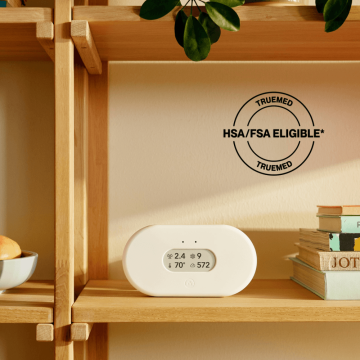
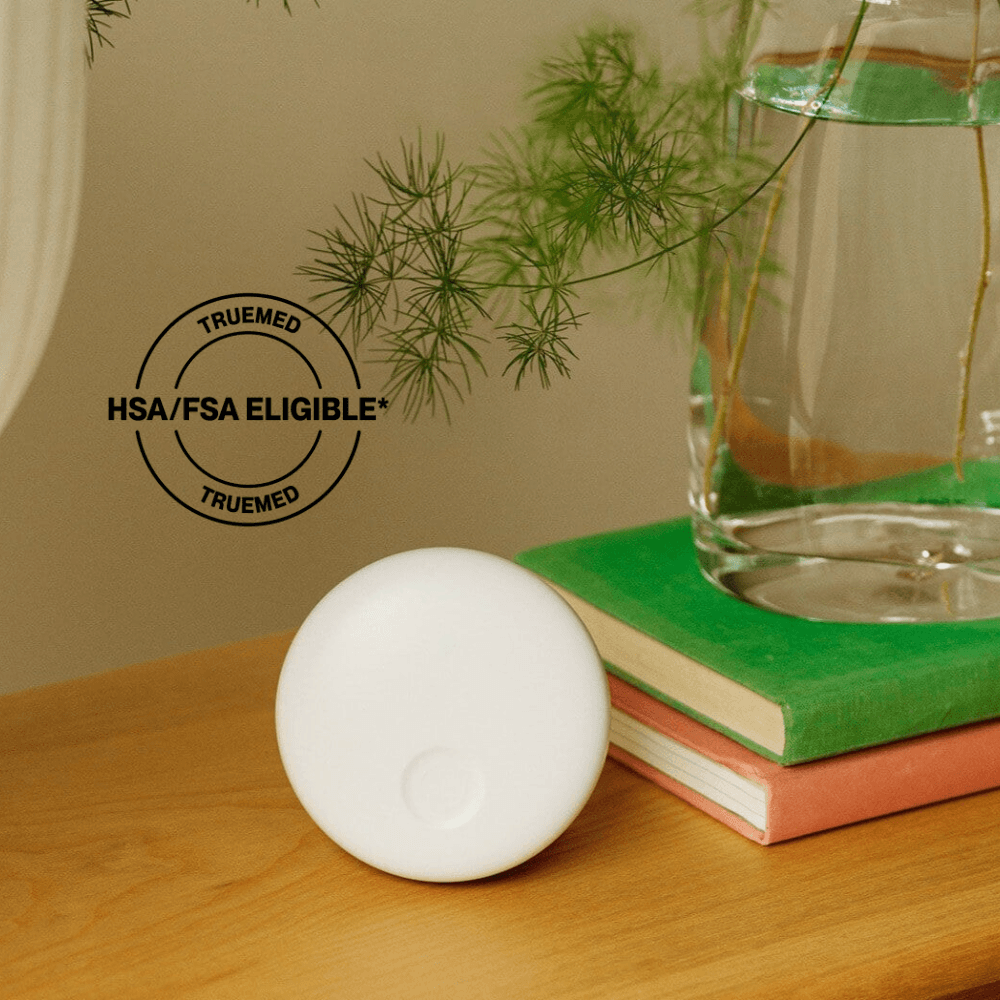
Tracks humidity, temperature, CO₂, and VOCs, so you can see how damp and stuffy a room gets overnight.
Shop now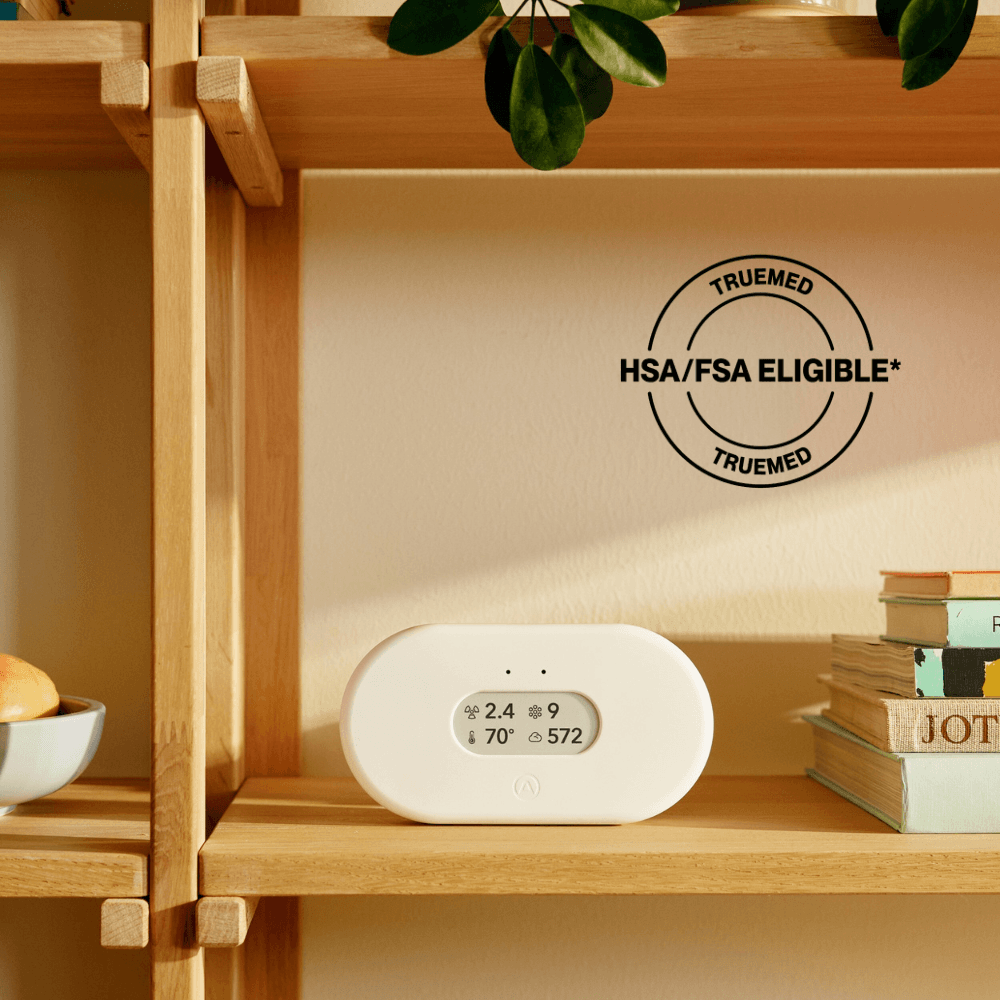
View Plus
Humidity plus radon, PM2.5, CO₂, VOCs, and temperature: the complete picture for your main living space.
Shop now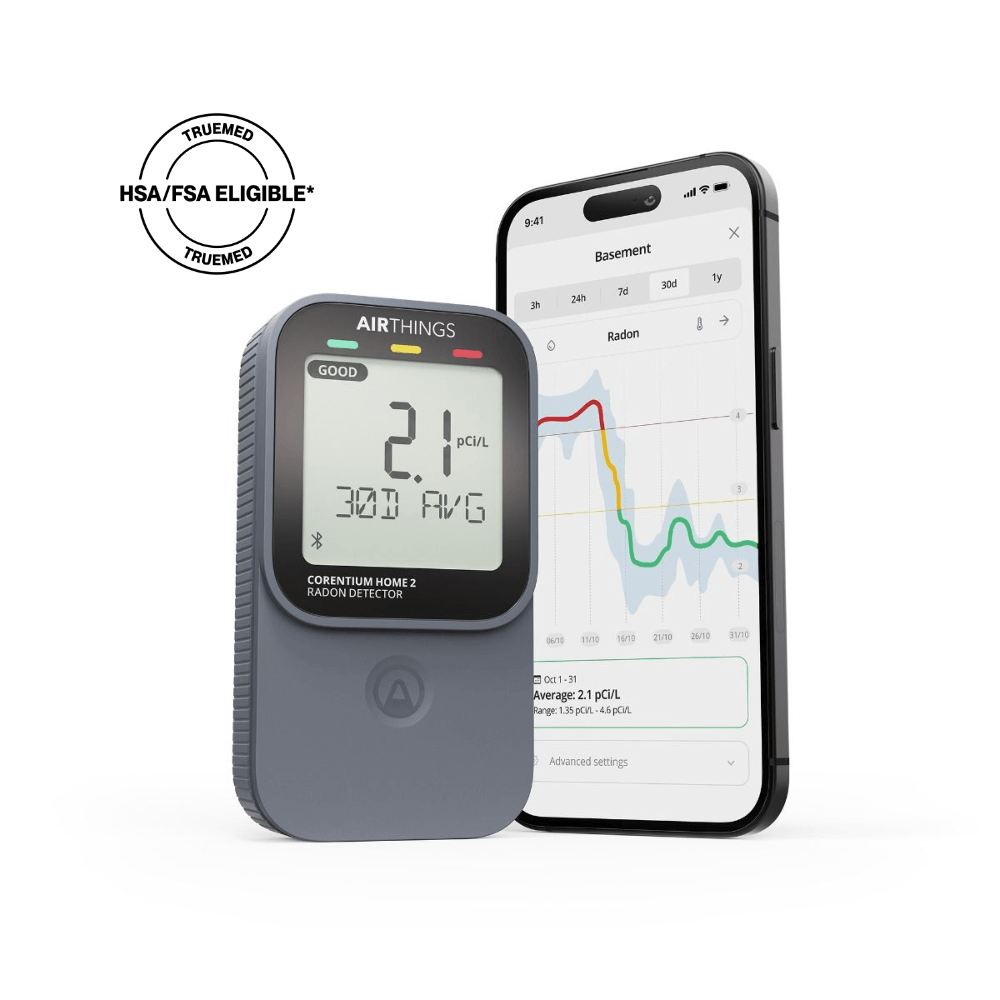
Corentium Home 2
Radon monitor with humidity and temperature sensors, for the damp lower floors where mold and radon are most common.
Shop nowNot sure which one? Compare Airthings monitors →
What is the ideal humidity level for a house?
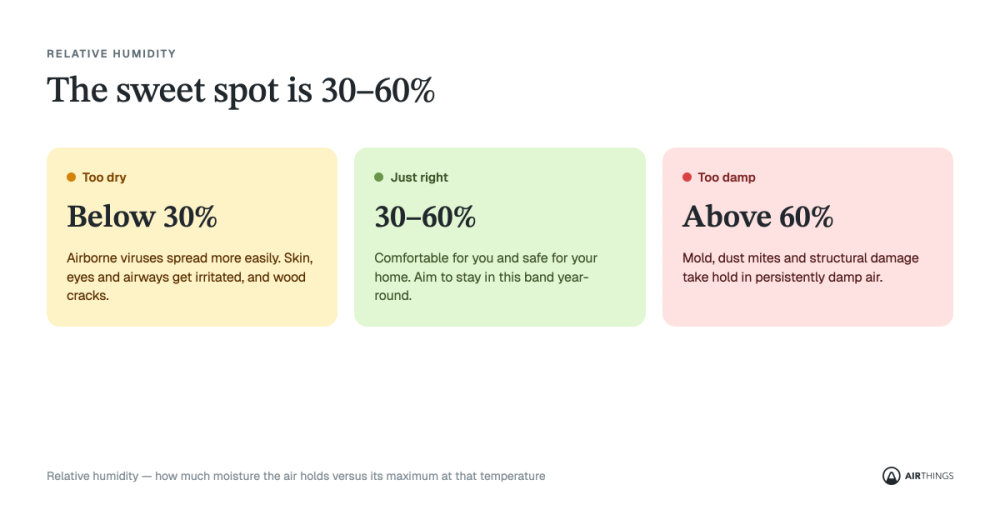
The US Environmental Protection Agency (EPA) advises keeping indoor relative humidity below 60%, ideally between 30% and 50%.
At Airthings, we treat 30% to 60% as the acceptable range for most homes, with 30–50% as the target. Within this window the air is moist enough to keep skin and airways comfortable, but dry enough to discourage mold growth and dust mites.
Ideal humidity by room
- Bedroom: 40–50%, comfortable for breathing and sleep, while limiting dust mites.
- Living room: 30–50%.
- Bathroom: spikes after showers are normal; it should fall back below 60% within an hour or so with the exhaust fan running.
- Basement: below 60%, and ideally 30–50%. Basements are the most common place for damp and mold, so they are worth monitoring separately.
Winter humidity: why the right number depends on the weather outside
Mold doesn’t need the whole room to be humid; it needs damp surfaces. In winter, the inside of windows and exterior walls is much colder than the room, so air at 50% in the middle of the room can condense the moment it touches cold glass. The colder it is outside, the lower your indoor humidity needs to be to avoid condensation.
The Center for Energy and Environment (Minnesota) gives this general guide to maximum indoor humidity in winter:
| Outdoor temperature | Keep indoor humidity below |
|---|---|
| 20 to 40°F (−7 to 4°C) | 40% |
| 10 to 20°F (−12 to −7°C) | 35% |
| 0 to 10°F (−18 to −12°C) | 30% |
| −10 to 0°F (−23 to −18°C) | 25% |
| −20 to −10°F (−29 to −23°C) | 20% |
| Below −20°F (−29°C) | 15% |
In very cold spells, that means accepting drier air than you would like, for a few days, to protect your windows and walls. Well-insulated homes with modern windows can usually hold a little more. The simple test: if you see condensation or frost on the inside of your windows, your humidity is too high for the weather outside.
In warm, humid climates the problem is the opposite: sustained dampness rather than condensation, so the job is keeping humidity below 60% with air conditioning, dehumidifiers, and ventilation.
This is why the humidity thresholds on Airthings monitors are adjustable. Instead of one fixed number, you can set alerts in the Airthings app that suit your climate, your building, and your own comfort.
How to check the humidity in your house
You need a hygrometer (humidity meter). There are two options:
- Basic digital hygrometer: cheap and fine for a quick reading, but it only shows the current number, so you can miss overnight peaks or slow trends.
- Smart air quality monitor: measures humidity continuously, keeps the history, and alerts you when levels go too high or too low. Monitors like View Plus and Wave Enhance also track other pollutants that often rise with humidity problems, such as VOCs and CO₂ from poor ventilation.
Place the meter at breathing height, away from showers, kettles, radiators, and direct sunlight, and give it a few days before drawing conclusions. If you suspect damp, put one in the basement and one in a bedroom. For a wider check, see how to test indoor air quality at home.
What is relative humidity?
Humidity is the amount of water vapor in the air. Monitors and weather forecasts almost always report relative humidity (RH): how much water the air holds compared with the maximum it could hold at its current temperature, expressed as a percentage. At 100% RH the air is saturated and water condenses.
How temperature affects humidity
Warm air can hold much more moisture than cold air. When cold winter air comes inside and is heated to 72°F (22°C), the amount of water stays the same but the relative humidity plummets, which is why homes feel so dry in winter. In summer, warm, humid outdoor air does the opposite, and your air conditioner has to remove the extra moisture.
Signs and causes of high humidity in a house
Common signs:
- Condensation or water droplets on the inside of windows
- A musty smell, especially in basements, closets, or bathrooms
- Mold or mildew spots on walls, ceilings, window frames, or grout
- Peeling paint, bubbling or curling wallpaper
- Warped wooden floors, swollen doors that stick
- Air that feels heavy, clammy, or stuffy; worse allergy or asthma symptoms
Common causes: showering, cooking, drying laundry indoors, and even breathing, combined with poor ventilation. Other causes include damp basements and crawl spaces, leaks, unvented dryers, an oversized air conditioner that cools without running long enough to dehumidify, and humid outdoor air in summer.
The dangers of high indoor humidity (above 60%)
1. Health impacts: mold, dust mites, and asthma
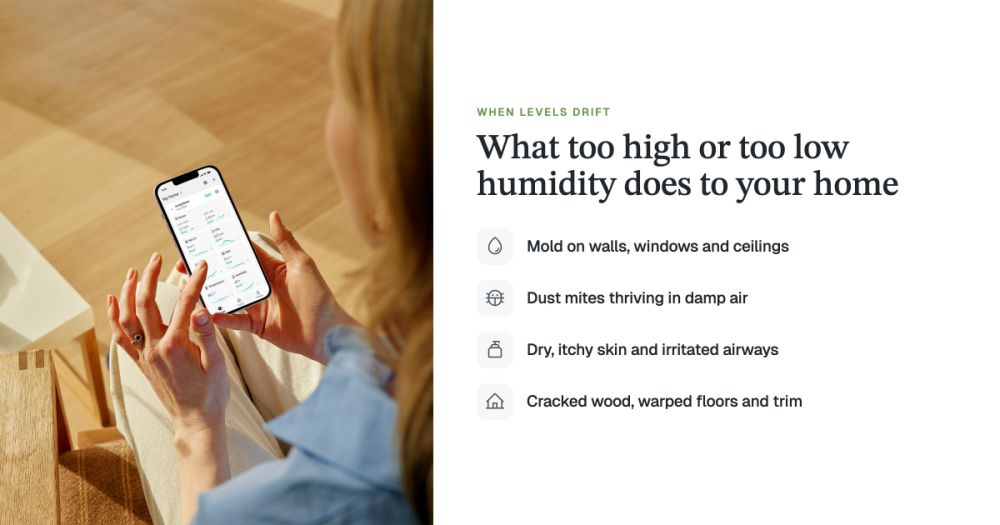
- Dust mites: a leading trigger for asthma and allergies. They absorb water directly from the air, so they thrive in humid homes and multiply faster as humidity rises above 50%.
- Mold and mildew: according to the EPA, controlling moisture is the key to controlling indoor mold. Spores settle on damp surfaces, like bathroom walls or windowsills, and grow. Mold can trigger allergy symptoms and asthma attacks, and irritate the eyes, nose, throat, and lungs.
As the EPA reports, young children are especially vulnerable to mold because their lungs are still developing and they breathe in more air relative to their size. Exposure can contribute to respiratory illness and asthma.
So-called "black mold" (Stachybotrys chartarum) gets the most attention, but health agencies treat all indoor mold the same way: remove it and fix the moisture behind it. The EPA suggests getting professional help if the moldy area is larger than about 10 square feet. For what mold is, where it grows, and how to remove it safely, read our guide: What is mold? Why it grows indoors and how to stop it.
2. Home damage: rot, peeling paint, and structural decay
- Condensation and paint: humid air condenses on cooler surfaces such as exterior walls and windows, making wallpaper curl and paint bubble and flake.
- Wood rot: wooden furniture, window frames, and floors absorb moisture, swell, and warp. Over time, persistent dampness can lead to rot in joists and framing and costly repairs.
Why low humidity (below 30%) can harm your health and home
Low humidity is most common in winter, when heating dries the air.
An example from the Airthings offices: Most of the Airthings team is based in Oslo, Norway, where winters can be very cold and dry. During a recent cold snap, we noticed dry throats, hands, and lips. Our air quality dashboard showed humidity frequently well below 30%.
1. Health impacts: airborne viruses and dry skin
- Virus survival: Stanford University research published in 2024 found that as humidity rises, airborne water microdroplets carry more naturally occurring disinfectants such as hydrogen peroxide, which may help neutralize viruses. Dry indoor air reduces this effect, which could help explain why respiratory illnesses such as flu and COVID-19 spread more in winter. The researchers note that experts have long recommended 40–60% indoor humidity.
- Skin and eye irritation: very dry air leads to itchy eyes, chapped lips, and flare-ups of skin conditions like eczema. It also dries out the mucous membranes in your nose and throat, which are part of your body’s natural defenses.
2. Home damage: shrinking wood and static electricity
Persistently dry air makes hardwood floors gap, wooden instruments crack, and door frames shift. Low humidity also increases static electricity, which can damage sensitive electronics.
Humidity also affects sleep quality
According to the Sleep Foundation:
- High humidity can increase wakefulness and reduce time in slow-wave and REM sleep, both important for recovery and memory.
- Low humidity affects comfort, causing a dry, scratchy throat and itchy skin that disturb sleep.
A bedroom monitor such as Wave Enhance shows how humidity and CO₂ change while you sleep. Read our guide: How indoor air quality is ruining your sleep, and how to fix it.
How to lower humidity in your house
Start by measuring. A continuous monitor like View Plus or Wave Enhance tracks humidity 24/7 and alerts you when it drifts outside your range (by default, below 30% or above 60%; you can adjust both in the Airthings app). Corentium Home 2 also measures humidity and temperature, which makes it useful in basements where damp is common. Once you know your baseline:
- Ventilate: run the bathroom fan during and after showers and the range hood while cooking. Open a window as well if the air outside is drier.
- Dehumidify: use a dehumidifier in damp areas such as basements and crawl spaces, set to keep humidity below 50–60%. Make sure your air conditioner is correctly sized; an oversized unit cools the house too fast to remove moisture.
- Fix the source: repair leaks, vent the clothes dryer outdoors, and keep gutters and downspouts directing water away from the foundation. The EPA advises drying any water-damaged area within 24–48 hours.
- Change habits: dry laundry outside or in a ventilated room with a dehumidifier, and keep the bathroom door closed while showering.
Check that it's working: after you make a change, watch your humidity history for a week. If levels don't settle back into the 30–50% range, the moisture source hasn't been fixed. Wave Enhance (bedrooms and living rooms) and Corentium Home 2 (basements) make this easy to track.
How to raise humidity in your house
- Use a humidifier: a portable or whole-house humidifier adds moisture in winter. Clean it regularly so bacteria and mold aren’t pumped into your home.
- Passive moisture: leave the bathroom door open after showering, or air-dry clothes indoors on a rack. Simple and free.
- Don’t overdo it: in cold weather, check the winter chart above and stop if condensation appears on windows.
A note on humidifiers and fine particles (PM2.5)
Ultrasonic humidifiers filled with tap water can turn minerals in the water into fine particles (PM2.5) that spread through the home. The American Lung Association describes a case where a father found PM2.5 levels in his son’s bedroom comparable to wildfire smoke. Use distilled or demineralized water, clean the humidifier regularly, and dry it before storing. A monitor that measures PM2.5, such as View Plus, will show you if your humidifier is adding particles. More on this: A guide to PM1, PM2.5 and PM10 and how it affects our health.
Frequently asked questions
What is a normal humidity level in a house?
Between 30% and 50% relative humidity, and below 60% at all times, according to the EPA. Short spikes after showers or cooking are normal as long as levels drop back quickly.
Is 70% humidity too high in a house?
Yes. 70% or more is too high for any home. Mold, mildew, and dust mites thrive, and condensation can soak into windows, walls, and wood. If your home stays at 70% beyond short spikes, find the moisture source, ventilate, and run a dehumidifier until levels are back below 60%.
Is 60% or 65% humidity OK in a house?
60% is the upper limit, and 65% is above it. Short spikes are fine, but if your home stays at 60–65% for long periods, conditions favor mold and dust mites. In cold climates, aim lower in winter.
Is 55% humidity too high?
Not dangerous, but at the top of what’s comfortable. If it stays at 55% or more, improve ventilation and watch cold windows and walls for condensation, especially in winter.
What should indoor humidity be in winter?
Usually 30–40%, and lower in very cold weather. As a rule of thumb, keep it below 40% when it’s 20–40°F outside and below 30% when it’s 0–10°F, and reduce it further if condensation forms on your windows.
What humidity level causes mold?
Mold needs damp surfaces, roughly 80% relative humidity right at a wall, window, or floor. That can happen even when the room reads lower, because cold surfaces cool the air next to them. Keeping room humidity below 60% (and lower in cold weather) keeps those surfaces dry. See our guide to mold.
What is the best humidity level for sleeping?
Between 40% and 50% in the bedroom. This keeps your nose and throat comfortable while limiting dust mites and night-time stuffiness.
What humidity should a basement be?
Below 60%, ideally 30–50%. Basements are cool and close to the ground, so they get damp easily. A dehumidifier and a monitor with alerts, such as Corentium Home 2, which also measures radon, help keep them in range.
What causes high humidity indoors?
Cooking, showering, laundry, and breathing, combined with poor ventilation. Damp basements, leaks, unvented dryers, oversized air conditioners, and humid outdoor air in summer also contribute.
What are the signs of low humidity in a home?
Dry, itchy skin and eyes, frequent static shocks, dry throats or nosebleeds, and gaps in wooden floors or cracked wooden furniture.
How do I measure humidity in my home?
Use a hygrometer. A continuous air quality monitor like View Plus or Wave Enhance shows how humidity changes through the day and night and alerts you when it moves outside your range, so you can act before it becomes a problem.
Can high humidity make you sick?
Not directly, but it creates conditions that can. Sustained high humidity helps mold and dust mites thrive, which can trigger allergies and asthma. People with asthma, allergies, or weakened immune systems are particularly vulnerable.
Will opening windows reduce indoor humidity?
Only if the outdoor air is drier. If it’s cool and dry outside, opening a window flushes out moisture; if it’s hot and humid, it adds moisture. Check the weather and your monitor first.
Does humidity affect how hot a room feels?
Yes. High humidity slows the evaporation of sweat, so a humid room at 75°F (24°C) feels much warmer than a dry one. In the bedroom this works against the drop in body temperature that helps you fall asleep.
Can humidity damage my home?
Yes. Sustained high humidity warps wood, makes paint peel, rusts metal, and lets mold grow inside walls, under floors, and in ceilings. The EPA advises drying water-damaged areas within 24–48 hours to prevent mold growth.
Sources
- US EPA (A brief guide to mold, moisture and your home: keep humidity below 60%, ideally 30–50%)
- US EPA (Mold course, chapter 2)
- US EPA (Mold exposure and respiratory conditions in young children)
- Center for Energy and Environment (Managing indoor humidity levels, all year round)
- Stanford University (How low humidity could be a boon for viruses, 2024)
- NIH (Absolute humidity and airborne virus survival)
- US EPA (Care for your air: a guide to indoor air quality)
- American Lung Association (Is your humidifier putting your health at risk?)