What is CO2, and how do you reduce high CO2 levels in your home?
TL;DR: Indoors, CO₂ (carbon dioxide) mainly comes from people breathing out, and it builds up when a home isn’t well-ventilated. It’s measured in “ppm” (parts per million). Under 800 ppm is excellent; 800–1,000 ppm means the air is getting stale; above 1,000 ppm you’ll notice stuffiness, brain fog, poorer sleep, headaches, and drowsiness. Closed bedrooms are the most common problem spot. The fastest way to reduce CO₂ is ventilation: open a window, leave interior doors open, and run exhaust fans. A CO₂ monitor tells you when it’s time to act.
Carbon dioxide is one of the easiest indoor air quality problems to fix, once you know it’s there. Below, you’ll find what a healthy CO₂ level looks like, how to bring high levels down (including in your bedroom), what causes CO₂ to build up, and how it affects your focus, sleep, and health.
What is carbon dioxide?
Carbon dioxide (CO₂) is a natural, colorless, and odorless gas, also referred to as a “greenhouse gas”. Outdoors, CO₂ is a vital part of the earth’s ecosystem, necessary for plant photosynthesis and life itself. But indoors, it is a completely different story.
What should the CO₂ level be inside my home?
CO₂ is measured in parts per million (ppm). Outdoor air today typically sits at roughly 420–430 ppm, so generally speaking, the closer your indoor levels are to outdoor air, the better.
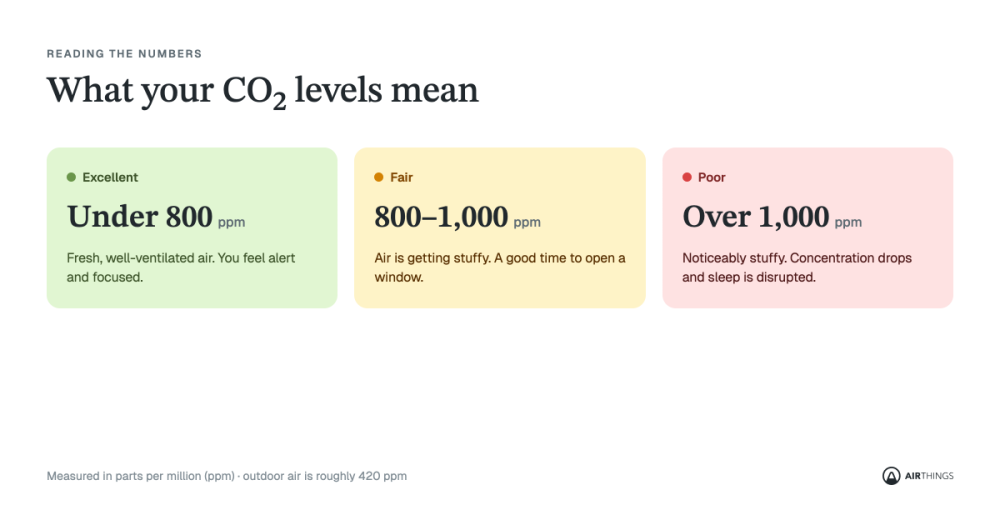
To understand CO₂ levels in your home, first you need to measure them with a CO₂ monitor. Here’s what the different levels mean for your air quality:
| Indoor CO₂ | What it means | What to do |
|---|---|---|
| Under 800 ppm | Excellent. Your home is well-ventilated and the air is fresh. | Keep doing what you’re doing. |
| 800–1,000 ppm | Fair. The air is starting to get stale and you may feel mildly drowsy. | Open a window or interior doors, or run an exhaust fan. |
| 1,000–2,000 ppm | Poor. The air feels stuffy, focus drops, and headaches and restlessness become common. | Ventilate now, and look at why the room isn’t getting fresh air. |
| Above 2,000 ppm | Very poor. A sign of a serious ventilation problem; common in closed bedrooms overnight. | Ventilate straight away and change the room’s routine (see below). |
How do you reduce CO₂ levels in your home?
Ventilation is the best way to reduce CO₂: replacing indoor air with fresh outdoor air. Once you know your levels are rising, use these simple strategies to bring them down.
1. Open windows and interior doors
The easiest fix is opening a window or leaving interior doors ajar. Even a few minutes of airing out can bring CO₂ back down quickly, especially when several people are in the same room.
2. How to reduce CO₂ in your bedroom
Bedrooms are where CO₂ builds up most, because the door and windows are often closed for hours while you breathe the same air all night. Cracking a bedroom window a few inches at night can drastically lower CO₂ and improve your sleep. If you can’t leave a window open due to security concerns or poor air quality outside, leaving your bedroom door open can also help. Airing the room out before bed helps you start the night with fresher air.
3. Bring in fresh air through your HVAC and exhaust fans
Ensure your home’s central air or ventilation system is pulling in fresh air from outside rather than just recirculating stale air. Run bathroom and kitchen exhaust fans, which pull indoor air outside.
4. Limit open flames
Reduce the use of gas stoves without range hoods, and limit burning candles or using wood fireplaces, especially if you’re not able to ventilate with fresh air.
5. Don’t rely on house plants
While plants do absorb CO₂ during photosynthesis, you would sadly need an indoor jungle of hundreds of plants to make a measurable dent in your home’s CO₂ levels. Rely on ventilation, not vegetation, for fresh air.
Know your number: You can’t see or smell CO₂, and a room can feel fine while levels climb. A continuous monitor tracks CO₂ around the clock and tells you when it’s time to open a window.
- View Plus: CO₂ alongside radon, PM2.5, VOCs, humidity, and more, with real-time data, history, and alerts to your phone.
- Wave Enhance: tracks CO₂ and other key air quality factors in bedrooms and living spaces.
Not sure which is right for you? See how Airthings monitors compare.
What causes high CO₂ levels in a house?
Indoor carbon dioxide comes from people, poor ventilation, or combustion (burning things). Here’s a breakdown of each:
- People (respiration): Every time someone breathes out, they release CO₂. In enclosed spaces like bedrooms, classrooms, or home offices, human breathing is the primary source of CO₂ buildup.
- Poor ventilation: Modern homes are built to be airtight to conserve heating and cooling energy. While great for your utility bill, this traps exhaled air inside, leading to CO₂ build-up. Many HVAC systems simply recirculate the same stale air rather than pulling in fresh air from outside. Because we spend up to 90% of our time indoors, the CO₂ we exhale can build up quickly.
- Combustion: Burning fuels indoors, such as using gas stoves, space heaters, or even burning candles, also releases additional CO₂ into your living space. Learn how other sources of combustion impact air quality in our guide to fine particulate matter (PM2.5).
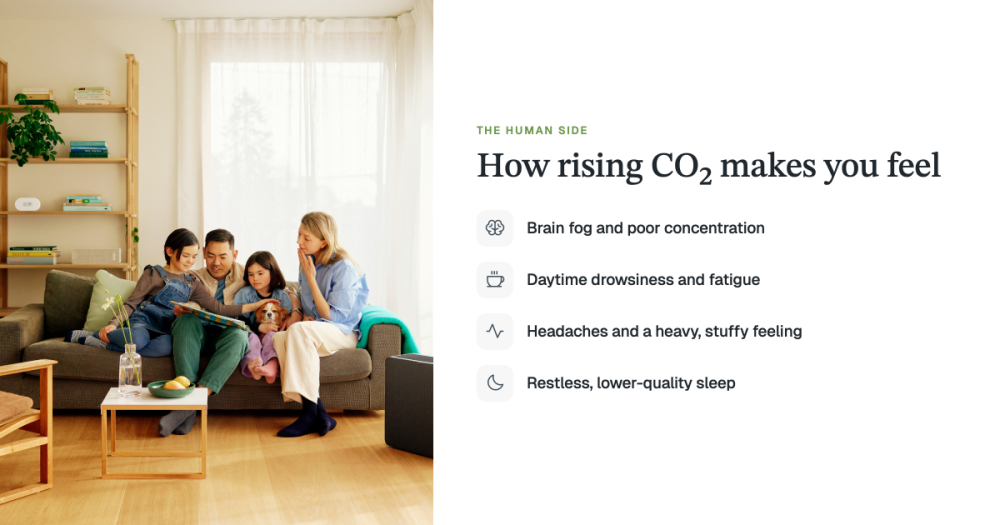
CO₂ builds up fastest when several people share a closed room.
Is CO₂ the same thing as CO?
No, they are completely different. CO₂ is carbon dioxide, which at worst will make you drowsy, less productive, and disrupt your sleep. CO is carbon monoxide. This is a highly dangerous, potentially fatal gas caused by faulty appliances. Always keep an active carbon monoxide alarm in your home.
Symptoms of high CO₂ in your house: how it affects your health
CO₂ is not toxic in typical indoor amounts. However, high CO₂ levels do directly impact how you feel, work, and sleep. It’s often described as a “brain fog” feeling.
1. Brain fog and poor focus and productivity
If you find yourself losing focus or feeling sluggish in your home office during the afternoon, CO₂ is a likely culprit. Research from the Harvard T.H. Chan School of Public Health found that with every 500 ppm increase in CO₂, response times to a simple cognitive test slowed by 1.4–1.8%, and throughput dropped by 2.1–2.4%. In the same research program, cognitive test scores were 101% higher in well-ventilated, low-pollutant conditions than in conventional office conditions. In schools, well-ventilated classrooms with lower CO₂ levels are consistently linked to faster learning and higher test scores in math and reading.
2. Restless and poor quality sleep
We spend a third of our lives in our bedrooms. With the door closed and windows shut, CO₂ levels can easily reach way above 2,000 ppm. Research shows that high CO₂ concentrations in bedrooms lead to restlessness, reduced sleep efficiency, and a groggy feeling the next morning.
Learn more about how CO₂ and other indoor air quality issues can impact sleep in our article, How indoor air quality is ruining your sleep, and how to fix it.
3. Physical symptoms
Common physical symptoms of high indoor CO₂, especially above 2,000 ppm, include:
- Drowsiness and fatigue (cue lots of yawning)
- Headaches
- Increased heart rate
- Mild shortness of breath or “stuffy” air sensations
Does lower CO₂ have other health benefits?
As the US CDC (Centers for Disease Control and Prevention) states, good ventilation in your home can also help to reduce the risk of virus transmission, and low CO₂ is a useful sign that a room is well-ventilated. While more significant in workplaces and schools, keeping your home well-ventilated in virus season, especially when people are gathering together, can have the added benefit of helping to reduce the spread of respiratory viruses, such as colds, flu, and COVID-19.
How do I know what my home’s CO₂ levels are?
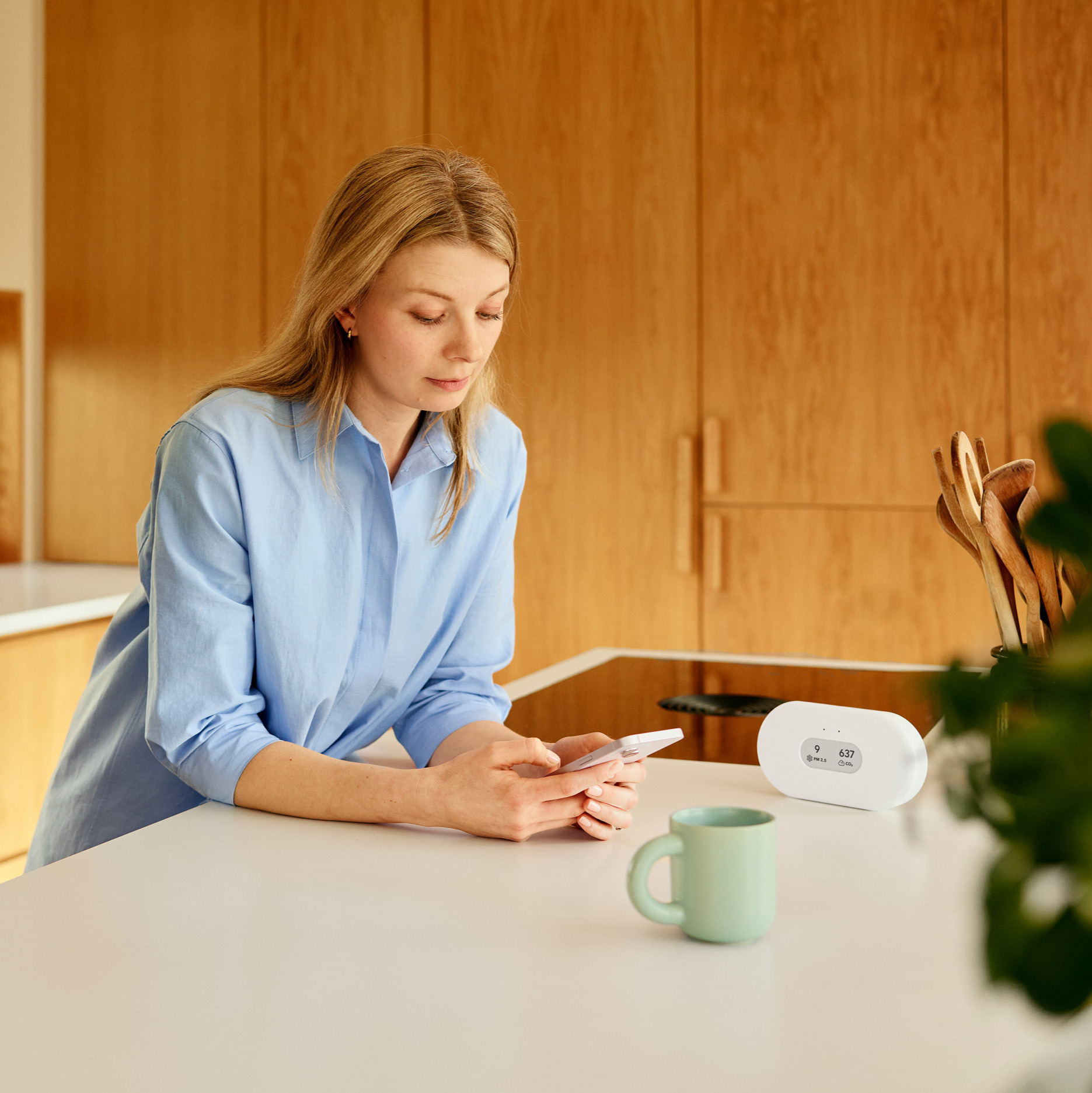
Using a dedicated air quality monitor with a CO₂ sensor is the only way to know what your home’s actual CO₂ levels are. A monitor like the Airthings View Plus or Wave Enhance can continuously track CO₂, alongside a range of other air quality factors, and send notifications to you when it’s time to open a window.
Read our dedicated guide on how to test air quality in your home to get more tips on perfecting your indoor environment.
Your home should be a healthy, relaxing, and productive place to be. By monitoring your air quality to understand and control carbon dioxide, you can breathe easier, sleep better, and think clearer.
Frequently Asked Questions (FAQ)
How do I reduce CO₂ in my home?
Ventilate. Open windows, leave interior doors open, run bathroom and kitchen exhaust fans, and make sure your ventilation system (if you have one) is drawing in fresh air from outside rather than recirculating stale air. Limiting open flames, like gas stoves without a range hood and candles, also helps.
How do I reduce CO₂ in my bedroom?
Crack a window a few inches at night, or leave the bedroom door open if a window isn’t an option. Air the room out before bed, especially if two people sleep in it. A monitor in the bedroom shows you how high levels get overnight and whether your changes are working.
What is a normal CO₂ level in a home?
Under 800 ppm is excellent and means your home is well-ventilated. 800–1,000 ppm is fair, and above 1,000 ppm the air will feel stuffy and start to affect focus and sleep.
What causes high CO₂ levels in a house?
The main cause is people breathing in rooms that don’t get enough fresh air, such as closed bedrooms and home offices. Airtight, energy-efficient homes, ventilation systems that recirculate air, and burning fuels indoors (gas stoves, fireplaces, candles) all add to it.
What are the symptoms of high CO₂ in a house?
Stuffy air, drowsiness, brain fog, poor concentration, headaches, restless sleep, and waking up groggy are the most common signs. These usually appear above 1,000 ppm and become more noticeable above 2,000 ppm.
Does CO₂ make you sleepy?
Yes. High levels of indoor carbon dioxide are a sign of stale, poorly ventilated air, and are linked to drowsiness, lethargy, and a lack of focus, particularly in enclosed spaces like offices and bedrooms.
What is a dangerous level of CO₂ indoors?
While rarely dangerous in homes, CO₂ levels above 1,000 ppm can cause headaches, brain fog, and restlessness. Levels exceeding 2,000 ppm indicate severe ventilation issues and will cause significant discomfort.
How do I test for CO₂?
An indoor air quality monitor with a CO₂ sensor is the best way to find out your home’s CO₂ levels. Use it in the spaces you spend the most time, such as a bedroom or home office.
Does high CO₂ affect children more than adults?
Research suggests children are more vulnerable to the effects of high CO₂ than adults. A study found that attention levels of school-aged children decreased by approximately 5% when exposed to a CO₂ concentration of 2,909 ppm compared to that at 690 ppm.
Do air purifiers reduce CO₂?
No. Standard HEPA air purifiers are designed to capture solid particles (like dust, pollen, and PM2.5). They do not remove gases like carbon dioxide. To reduce CO₂, you must physically replace the indoor air with outdoor air through ventilation.
What is the difference between carbon dioxide (CO₂) and carbon monoxide (CO)?
Carbon dioxide (CO₂) is a naturally occurring gas we exhale, which causes stuffiness and fatigue in high concentrations. Carbon monoxide (CO) is a highly toxic, potentially deadly gas produced by the incomplete burning of fuels from faulty furnaces, water heaters, or cars.
How do I know if I have high CO₂?
While you can often tell if something is “off” with your air, such as a room feeling stuffy or stale, monitoring your indoor air quality with a device like Airthings View Plus can tell you what your CO₂ levels actually are.
Can plants reduce CO₂ in my home?
No, unfortunately you would need hundreds of plants in your home to reduce your CO₂ levels. Opening a window will have far more impact on your CO₂.
Sources